Manson Women Part 4
Needless to say if you haven't seen this show you should have and shame on you
Tuesday, July 11, 2006

Monday, July 10, 2006
My Life With Charles Manson Chapter the Fifteenth

Chapter 15
“Hurry up, goddamnit!” I urged. “This fucking truck is hot.”
It took no more than half an hour for us to load up with supplies: food, clothing, and several empty five-gallon drums. By the time Karate Dave and I and several girls pulled back onto the highway, it was about four A.M. The girls were still in their nighties and T-shirts and were excited as hell. I sensed their eagerness to be leaving for the desert; or was it my own projected delight? Dave and I sat in the front with Brenda between us. Dave and I sat in the front with Brenda between us. Dave wanted to drive, so I rolled a couple of joints and passed them back through the curtain behind the seat to Ouisch and Cappy. The back end of the truck, though spacious, was cluttered with pieces of hose, bricks, sacks of cement, and three or four well-stocked toolboxes. The girls pushed the stuff to the rear and sat in a circle just behind the seat. It was a beautiful dawn, and I rolled down the window to enjoy the fresh air as we droned north through
For some reason I flashed on Brooks Posten, who was then at Barker’s with Juanita. In my mind’s eye the changes in Brooks somehow reflected the changes in the Family. During our stay at
I smoked the last of the roach Brenda handed me and rolled up the window.
My feelings that night were even more confused. On the one hand, it was exciting ripping off the truck and running from the law. And I enjoyed playing commandos on the outskirts of
But that didn’t happen. Just outside Mojave, Dave shouted back at the girls, “Stash the dope; the heat’s on our ass.” Moments later we were pulled over by a highway-patrol unit for having no rear license plate, something no one had noticed in our eagerness to split.
One of the two cops scanned Dave’s driver’s license with a flashlight, then shone the light on me and Brenda.
“Hi,” Brenda said cheerily, waving her fingers.
“You people want to get out of the truck, please?”
“You mean all of us?”
“Yeah, all of you.”
Dave got out, and Brenda slid out behind him. I followed. Then the curtain parted and Snake’s shapely leg appeared as she climbed over the seat. She wore nothing but a T-shirt and her underpants, and the young cop who had opened the door to begin a search stood back and gaped. Then came Sandy, Ouisch, Cappy, Bo, Sherry, Sadie, and Crazy Patty.
The cops exchanged glances. While the older one eyeballed the girls with feigned nonchalance, the other searched the van top to bottom. He didn’t find any dope but he did uncover a license plate behind the back seat. After running a check on it, they took us all to Mojave. Dave and I were separated from the girls and spent what was left of the morning in a communal drunk tank. The next day they took me to L.A. county jail in a sheriff’s bus and booked me for suspected auto theft. I didn’t know what had happened to Dave or the girls. Two days later I was released. Apparently the truck had been stolen several times and they could find no registered owner. When I got back to Spahn’s, the girls were there. So was Dave; he had climbed out the bathroom window in Mojave during a court recess and had escaped the same night. A week later, Dave left the Family, and I never saw him again.
Returning to Spahn’s so suddenly, after anticipating a stay in the desert, made me even more aware of how degenerated things had become. Charlie was angry that we had not gotten there with the truck. Two weeks earlier he had sent another supply run to the desert, but the truck had broken down on the road and had to return. Charlie’s face reflected the tension; his capacity for patience, which had once seemed infinite, had all but disappeared. Walking around Spahn’s in the midst of a conglomeration of people – mechanics and motorcycle types, ex-cons and curiosity seekers – began to unnerve me. There was never a time when the Family was together as one unit; the communal acid trips and therapy sessions were a thing of the past, we were always disjointed, off on separate trips; when we were together, there was no longer a feeling of unity; there was only confusion and Charlie’s cryptic, acidic spiels about blackie and the shit coming down. I found myself alone more, roaming around the ranch in a state of detachment. I began violating Charlie’s rules, eating most meat and smoking pot during the day, like a child defying his parents. I did it unconsciously; yet, I flaunted it.
One afternoon in late June I found Charlie standing outside the saloon talking to Squeaky. When Squeaky walked back up the hill to George’s, I approached Charlie. He stood leaning against the building fingering his beard; his eyes were glazed. He didn’t see me until I was right beside him.
“What’s happening, Paul?” He put his arm around my shoulder and gave me an affectionate squeeze.
“When are we gonna go, man?… We gotta make it to the desert. Sometimes I think we’ll never get out of here…”
As we walked together toward the corral, Charlie still had his arm around my neck. “You’re right, brother, dig it. Helter-Skelter is ready to happen… it’s gotta happen soon. All the piggies are gonna get their jolt of where it’s really at. We have to stock supplies at the desert and be ready to boogie… I don’t know why we can’t get a truck up there. It’s startin’ to piss me off.”
We stopped at the corral gate and looked in at the horses. Charlie climbed up and sat on the top rung of the fence, looking down at me.
“I’ll tell ya, blackie never did anything without whitey showin’ him how.”
I looked up at Charlie, and he winked. “Helter-Skelter is coming down. But it looks like we’re gonna have to show blackie how to do it.”
My blood ran cold. The words echoed in my ear. “Show blackie how to do it!” I knew exactly what Charlie meant. All the horror I had been sensing flooded my being; it was like an instant nightmare lived out in silence. I did not look at Charlie, but gazed straight ahead at the horses, motionless save for their tails, which flicked intermittently at the flies. In that instant I flashed on the choking scene and the look on Charlie’s face. I saw Brooks Posten lying prone on the floor of the Gresham Street house. I saw the faces of the girls: Squeaky, Sandy, Ella, Sherry, Mary – all of them rapping out of the void of what remained of them, rapping all that was left: Helter-Skelter.
Without looking at him, I muttered, “When are we going to the desert?”
“I’ll tell ya what we’re doing.” Charlie hopped down from the fence and stood beside me, looking up toward the saloon. “We’re gonna load the fucking semi full of dune buggies and Harleys and we’re gonna take them to the desert; we’re gonna stockpile supplies up there right away.”
As he spoke, I felt a vague sense of reprieve, that if I could go to the desert it would be okay, that if I just got out of there, everything would work out. I did not want to think about Charlie’s remark, Up until that moment, I had gone all the way. I had believed in the beauty of what was once a reality. I had faced my fears, suffered countless ego deaths. I had loved Charlie and the others (I still did). I had done everything asked of me – pilfered credit cards, conned people, played the games. I had begged, borrowed, and stolen for Charlie. I had even seen and believed in qualities which seemed Christlike. I had submitted, accepted, and flowed with the love. I had said, “Yes, I am you and you are me. We are one.” I had swallowed Helter-Skelter. I had done everything to promote it. But unlike Sadie, Katie, Squeaky, Clem, and Tex, I had never really “ceased to exist.” And now from the deepest center of my self there was something that said, “No, good God, no!”
But it was all on the inside; it was all happening away from Charlie’s eyes. At the moment, I feared Charlie. But part of that fear was that he might be right; that Helter-Skelter was inevitable and that despite its horrors, we had to go through with it. I was equally afraid of myself, of the part of me which had become him. I didn’t really know who I was. I had little control. What moved me was an instinct to escape.
Charlie put me in charge of organizing the expedition to the desert. I went at it with gusto – getting the mechanics to finish their work and load up the supplies. It took several days to complete the work and get the Harleys and dune buggies ready for the trip. Sometime around the first of July, in the evening, we began hoisting the machinery onto the semi. I supervised everything, saw to it that the vehicles were well-secured and that all supplies were accounted for. It wasn’t until most of the loading had been completed that Charlie informed me I was to remain at Spahn’s.
By nine P.M. everything was ready. I trudged dejectedly back to the other semi trailer to tell Charlie. The trailer had become a central headquarters for the Family during the latter part of June; with all the parts and supplies pushed off to the sides, there was enough room to seat the entire Family. As usual, Charlie sat at the head of the group on a small stool, rapping out instructions, while Sandy, Ouisch, Mary, and some of the others were sewing buckskins.
“Hey,” I called in, “ready to go.”
Everyone filed out and gathered around Charlie in front of the saloon. Danny De Carlo and Bill Vance were lashing rope around the tailgate of the truck. “I need a couple of girls to go along with me,” Charlie said. All the girls jumped up and down. “Take me… me, Charlie!”
“What is this?” Charlie barked. “Am I some kind of schoolteacher or something?” He ordered Ouisch, Stephanie, Snake, and Brenda to get in the truck, then moments later drove out the driveway and disappeared down the road. What I felt then was a combination of confusion, anger, depression, and fear. After they had gone, I walked up to the outlaw shacks alone and sat on the steps. For some reason I thought of my old girlfriend Mona, a pretty blonde I’d known in Topanga Canyon before joining the Manson Family. In retrospect, I realize that this thought was not so unusual; unconsciously, I was grasping for a way out, even if it meant returning to my past.
But I didn’t have long to ponder the situation. In less than half an hour Charlie was back; he said the trailer wouldn’t trail the truck and had to be rerigged. He was furious.
“Goddammit, we just can’t get a motherfuckin’ truck up to Barker’s!”
I stood beside Brenda and Bo, near the rear of the rig.
“Look, Paul,” he barked suddenly. “Take Danny’s pickup and run some of these supplies up to Brooks and Juanita. They’re gonna wonder what the hell happened to us. He can use your truck, huh, Danny?”
“Be my guest.”
I was delighted! “I’m gonna need someone to go with me.” As I said this, the girls began to fidget and edge forward, wanting to go but afraid to speak up for fear Charlie would object. At that point, it became all too clear just how hung-up they were, how dependent on Charlie. Only moments before they’d reacted like a bunch of eager kids; now they were mute. Charlie saw it too and fell into a rage.
“Motherfuck! What’s happening around here? Everyone has to ask permission to breathe!”
I didn’t wait for him to finish. “Come on, Bo… you go with me.”
Charlie didn’t say a word as Bo and I climbed into the cab of Danny’s truck. There was a rule in the Family that only girls carried dope, and since we were taking some seeds up to Brooks and Juanita, we needed a girl to go along.
Charlie told me to deliver the supplies, stay a couple of days, and then come back to Spahn’s. I drove out the highway and headed for the freeway.
Danny’s truck had been recently tuned, and I tromped on it. The more distance I put between myself and Spahn’s, the better I felt. Bo, meanwhile, had begun to whimper and then to cry. It was nothing new for Bo. She seemed to have a predisposition to tears; it was her way of handling stress. During earlier scenes in which she became the center of attention – going through some ego death – her emotional output was extraordinary. All you could do was let it run its course. But I knew from our earlier conversation what she was feeling. At one point she put her head on my shoulder and clutched at my arm.
“Come on, Bo… Jesus… what’s wrong?”
“I feel heavy things coming down. It scares me. Charlie scares me.”
I didn’t really say anything. I just put my arm around her. Neither of us really know how to handle what was inside us; we’d both been so heavily programmed by that time that all natural impulses were trapped, blocked off. The desire to escape, to run, was being satisfied by being on the road. Yet, deep down, we were both tied to Charlie in ways we couldn’t begin to understand. We had come to believe in Charlie so deeply that truly doubting Helter-Skelter was impossible. Helter Skelter was coming down; our life at Spahn’s – disjointed, confused, fragmented – was an expression of it; it was happening. Charlie was causing it. There was more fear than before. Charlie had always told us fear was good and that we should submit to it. I remember the night he took Bo before the mirror and made her look at her body; I had learned that there was truth in his words: “Face your fears” – that by confronting fears I had gained knowledge. Had Charlie sensed my feelings, he would probably have told me that fear of violence is just another fear – that death is merely a release to the love. “Dying,” he had said, “is something like orgasm… it leaves you in a state of calm, a state of bliss.” The implication was that he had died before.
Inside, I was torn, my thoughts divided from my emotions. My instinct was to run, and I was running, so that looking out the window that night made me feel hopeful. But I was still locked into the programs, still a part of Charlie. I found myself rationalizing his words: “We’re gonna have to show blackie how to do it.” Maybe there was another way of showing him; maybe he meant something else. Charlie is a man of love; we are all submitting to his love; Helter-Skelter is to program the young love to come to the desert. I remembered the good scenes – feeling close, being loved. Outside, the night seemed infinite, opening wider as we drove on. I pushed harder into the center of the night, with Bo beside me, wanting to feel free, wanting to send my spirit beyond the horizon, sensing that if we could just go faster it might happen. But physical freedom was not enough; my insides were tied to Charlie and the Family in ways I hadn’t begun to sort out. I found myself latching onto phrases Charlie had taught us, like, “I am you and you are me,” and “No sense makes sense.” My mind would rest on one thought until another thought emerged to replace it; then another, and another, until it felt as though I were going mad. It was as if my being had been inhabited by so many contradictions that all thoughts and feelings – the very flow of my blood – was blocked. Who was I? What was left of me? Only the highway, straight and nearly empty of traffic, provided the illusion of direction and freedom. Yet, while all this raged in my psyche, I found myself soothing Bo with words which came from still another part of myself.
“It’s okay, Bo… we’re on a good trip now. We’re going back to the desert, just you and me… no bad vibes there… just the desert. Look at the sky, Bo.”
We watched the sun come up just outside Ballarat and stopped there to buy coffee. By eight that morning we were hiking up Golar Canyon toward the Barker ranch. Somehow, climbing the rocks lessened the tension, as I scrambled ahead of Bo, stopping every few minutes to wait for her. The closer we got to Barker’s, the faster I climbed. I found myself again anticipating seeing Brooks. I didn’t know why. It wasn’t as though Brooks and I had ever been close. But I believe, looking back, that I envied his being in the desert, away from what was happening. I also made a subconscious connection between Brooks’s “zombied-out” state while a Gresham Street and what was coming down in the Family. My urgency was also prompted by the fact that in less than a month’s time we’d sent three expeditions’ to the desert. None of them had arrived.
We rested midway up the canyon, then completed the hike without stopping.
When we reached the gate in front of the ranch, Brooks appeared on the porch.
“Hey Paul!” He called something into the house, then came bounding down the hill like a frisky goat. He wore Levi’s, a loose-fitting T-shirt, and worn-out Hush Puppies. I’d never seen Brooks move that fast or with as much agility. I couldn’t believe it was the same person. His blue eyes were clear. There was color in his cheeks. Even his shaggy blond hair looked healthy. He gave us both a warm hug.
“I was hoping they’d send you,” he said.
“Hey, man… you look good! This desert life must agree with you… what you been eatin’?”
“I’ve been climbing mountains.” He glanced over his shoulder toward the ranch house. “Met this far-out old prospector dude… he’s a trip.”
“How’s Juanita?” Bo wanted to know.
“Okay. She’s up there making some vegetable concoction. We got a little garden going.”
While Brooks spoke, I saw a man step out of the bunkhouse and sit down on a rock just outside the door.
“What’s goin’ on at Spahn’s… how’s Charlie?” Brooks asked both questions at once.
My answer was automatic and only half-conscious. I was still watching the man on the hill.
“The shit’s coming down.”
“Comin’ down fast,” Bo added.
“Hey, that’s him.” Brooks’s eyes followed my gaze. “Let’s go up, then I’ll help you bring in the supplies.” As we walked up the trail toward the house, the man stood up and lit a cigarette. He was of medium height, had short salt-and-pepper hair, and appeared slightly overweight. Dressed in Khaki pants and a plain short-sleeved shirt, he looked like the classic redneck pig, and I found myself growing suspicious as we approached him. Still, the transformation in Brooks was a strong recommendation of this man.
“What’s this dude’s name, anyway?” I muttered under my breath as we drew closer.
“Paul… Paul Crockett.”
COPYRIGHT PAUL WATKINS AND GUILLERMO SOLEDAD
Sunday, July 09, 2006
Alice LaBianca Speaks
You can say whatever you want- and I know you will. But if your husband divorces your ass and starts a new family, then is brutally murdered THEN you come along 25 years later to grab some TV face time, you are pathetic.
From 1994, Col Scott brings you Alice LaBianca and some kid who never knew a LaBianca.
At least it is not as worthless as her book.
You can say whatever you want- and I know you will. But if your husband divorces your ass and starts a new family, then is brutally murdered THEN you come along 25 years later to grab some TV face time, you are pathetic.
From 1994, Col Scott brings you Alice LaBianca and some kid who never knew a LaBianca.
At least it is not as worthless as her book.
Saturday, July 08, 2006
My Life With Charles Manson Chapter the Fourteenth

Chapter 14
Where the eagle flies
We will lie under the sun
Where the eagle flies
We will die…die to be one
The nights are so dark
And the wind’s so cold
Love’s fire is burnin…and you can’t grow old
Livin’ with the poison ones
Sun-in with the Devil’s sons…
-from a song written by Charles Manson
summer of 1969.
The more involved we became in Helter-Skelter, the harder it was to see anything else. Momentum carried us along with Charlie. To say no would have been to violate all that we had worked to achieve. Even when Charlie’s raps became more militant (I shuddered at some of his descriptions), it all seemed to fit with his earlier statements regarding death. We’d been programmed to think of death in a cosmic sense, knowing that the spirit never dies. We’d all experienced countless ego deaths and had watched each other experience them. We knew that life was merely a series of transitions in consciousness. When Charlie got into elaborating on the blood and gore of racial war, we all considered it a kind of therapy he was putting us through. At least I did. Blood and carnage were as much a part of life as anything else; the media were filled with it, seemed to thrive on it in fact. So long as we had no karmic connection with it, so long as we did nothing to cause it, we could view it without judgement. And at that point, there was never a hint that we would have any part in killing.
The emotional impact of living in the center of
Around the first of April we began gradually to move out of
Since we couldn’t move back to Spahn’s en masse, without causing suspicion, we had to do it a little at a time. We started by establishing a campsite in the ravine just below the ranch. Charlie and I purchased several parachutes from a surplus store in
Sometime in mid-April we made a final exit from the
Around May we left the mansion and moved back to Spahn’s, staying in the campsites so as not to disturb George and the wranglers. Charlie kept two girls with George at all times and told the old man we’d be helping out with wrangler chores. George said he was much obliged.
Once at Spahn’s, everything was geared towards Helter-Skelter and moving back to the desert. The acquisition of a huge open-topped semi-trailer bed (which we covered with tarps) gave us additional space to store parts, to work on the motorcycles, and to sleep up to fifteen people. We had mechanics rebuilding Harleys, diesels, and dune buggies round the clock. We paid them, and paid them well—in money, dope, and all the sex they could handle. Meanwhile, the tourists came to ride horseback, look at movie sets, and talk to the wranglers, who went about the business of tending George’s stock.
It was during this period that we met Danny De Carlo, a tough booze-addicted biker, who, at the time, was treasurer for a motorcycle gang known as the Straight Satans. Danny was a fast-talking, earthy little dude (five-eight) with a thick black “waterfall” hairdo, dark, direct eyes, and a passion for “beer and broads.” He invariably wore the full Levi’s garb (with “Straight Satan” embossed across his jacket) and boots, and walked like a Hell’s Kitchen hoodlum. He had a good sense of humor, a quick wit, and while blinded by his own prurient inclinations, he was, as the saying goes, nobody’s fool. He later told authorities that his rapport with Manson was enhanced by the fact that he (Danny) could satisfy Charlie’s girls sexually, thus taking the pressure off Charlie. While this was pretty farfetched (Charlie only allowed Danny access to certain girls), Danny did acquire the nickname “Donkey Dan”-A tribute to his “Size”; it was a sobriquet he was proud of.
We’d met Danny just before leaving the
De Carlo was born in
By the end of May the girls were designing buck-skins – all-purpose, combat-ready clothing which would last indefinitely and be conducive to life in the desert. At the same time,
In the midst of these preparations, Charlie moved about like a seasoned field general, giving orders. We set up camps in the creek bed and explored the mountains around Spahn’s so that we knew every hill and gully. We took dune buggies and Harleys into the canyons and worked on the road. At times Charlie would order us to evacuate one campsite and set up another. It was like commando training. We began to feel like a well trained band of guerrillas. Meanwhile, our mechanic worked on the vehicles, and our girls continued to dance topless and bring home fat paychecks to cover our burgeoning expenses. At night we played music in the saloon and sang the songs of revolution.
Charlie continued to make trips to
Linda was the epitome of the young flower child, on her own since sixteen. She’d traveled from the East Coast to California during the summer of love (’67) in search of spiritual fulfillment; she’s lived in Taos and Seattle; she’d worn flowers in her hair at Haight Ashbury; she’d crashed in cheap hotels and communes and had taken psychedelics in quantity before coming to Spahn’s late that summer with her two-year-old daughter, Tanya. Linda was five-one and petite, with long light brown hair, green eyes, and a soft, clear speaking voice. When she met Charlie, shortly after I met the Family, she was nineteen and certainly no novice to the jargon of the time. Yet, she fell for his rap hook, line, and sinker. One month later, he sent her to kill.
As things became more fragmented, Charlie’s bitterness and frustration surfaced with greater frequency. He began sprouting “death to the piggies” and quoting from the Beatles’ album. He said we had to work faster; once again we took our group to a studio for a recording session in the valley, but things fell apart; Charlie got pissed off at the technicians and we split. One evening, a short time later, we were practicing in the saloon. Charlie was sitting on a stool in front of the mike, with Bobby to his left, playing the drums.
“Sing what?”
“Anything, just sing.”
“But… what do -?”
“Goddammit, sing!” Charlie walked over and yanked her hair.
“Ahhh.”
“That’s a sound, now try something else.” He jerked her hair again.
“Oweee.”
“Good, now sing.”
She sang.”
Cleanliness became a real problem; with no access to indoor facilities, we were forced to go for days without bathing. We all rinsed off in the creek regularly, but it was hard to stay clean. People have been led to believe that the Manson Family was “dirty and unkempt,” but this was not the case. Up until the summer of 1969, Charlie demanded good personal hygiene, and that clothes, food, musical instruments – everything – be kept orderly. But living at Spahn’s like commandos made it impossible to maintain these standards. The natural, easygoing rhythm of life we had enjoyed gradually became too diffused and disjointed, and finally, decadent. With bikers and hippies and strangers coming and going at all times, there was little opportunity to put the old scene together. Still, there were moments – those nights when the girls made meals at the campfire and we sang songs and Charlie rapped. Those nights were soothing and I remember lying beside Snake in the tent listening to the crickets and wondering what the future held for us. I made love to Snake a lot during that period. It was one experience that always felt right. With Snake I shared a kind of inner harmony that sustained me even when things started coming apart. It was not that Snake and I spent a lot of time together or that we consciously cultivated a “special” friendship; it was just that when we were together, it was special. It was something neither of us talked about, but it was there from the beginning, from the day I arrived, and Charlie sent her to seduce me by the same creek bed, just one year before.
Months later, lawyers, law-enforcement authorities, and friends would ask me why, when things had degenerated so, I remained with the Family. What needs did the family fulfill? Why didn’t I split? It’s hard for people to understand what deep needs were met by the Family. I can only say that living day in day out with a group of people with whom you’ve shared all manner of experiences, without inhibition, binds you deeply. It wasn’t only Charlie. I was close to everyone. It have me a feeling of security against the impersonality of the world. I felt we shared more than any genetic family; we shared a kind of communication that is rare between people. The Family met many needs: sexual, spiritual, communal, recreational, artistic. We were brothers, sisters, fathers, mothers, lovers to each other. We were one. It was a hard thing to let go of, even when it all faltered. Rather than leave it and invalidate all that was good, it seemed easier to ignore or refuse to acknowledge the changing vibes, the degeneration. I had experienced fears before, and they had been dissipated through confrontation. Charlie taught me to submit to these changes. I had endured the choking, the freak-out, and a good deal more. Plus, if Charlie was right and Helter-Skelter was coming down like he said, I needed him and the Family to survive.
But others, too, were feeling the change. One afternoon I was hiking up from the campsite toward the saloon. Charlie had asked me to help the mechanic assemble a new Harley. I’d just researched the saloon when Bo came up and started walking with me. She was a full-length gingham dress and was barefoot. Her face was smudged with dust and she’d lost so much weight that her eyes seemed enormous. All of us had begun eating less; with no place to cook but the campfire, it was difficult to prepare meals for so many, so that we resorted to living off sweet rolls and cakes, which we continued to get in quantity from our bakery connection in
“What’s the matter, Bo?”
“I don’t know. I just feel…”
She stopped when we reached the semitruck, and the mechanic, a guy we call Turk (a friend of Bill Vance’s) stuck his head out the trailer. “What’s happening, Turk?”
“Did De Carlo ever bring them plugs?”
“I don’t know.”
“Shit.” Turk wiped his forehead with a greasy rag, then stuffed it in his back pocket. “Where’s Charlie?”
“Down at the corral, talking to Tex.”
Turk jumped out of the semi and trotted toward the corral.
When he was out of earshot, Bo told me Charlie had scared the shit out of her. “Charlie said when Helter-Skelter comes down they’ll come looking for me, and if they find me, they’ll chop me up. He said blackie’s gonna terrorize everyone. He said they’re gonna smear the piggies’ eyeballs on the ceilings and paint the walls and floors with blood.”
I knew what Bo was feeling. I had experienced Charlie’s demonic side. Yet, I did not want to acknowledge it. I wanted to move beyond Helter-Skelter; to go back to the desert. But things only got worse. And my own fears and uncertainties became apparent to Charlie.
One night, not too long after my conversation with Bo, Charlie asked me to go with him to Canoga Park to pick up some girls. He said we needed to relax and have a good time. I’d worked all day with Turk and Tex, helping pack and assemble parts so we could transport them to Barker’s. I’d crashed out in the semitrailer in my sleeping bag and had just dozed off when Charlie woke me.
We took the milk truck and drove down to Topanga Canyon Boulevard, then turned left on Chatsworth. Charlie was talkative, but I sensed that some of it was put on, that he was trying too hard to be his “old self.” Somewhere near the Topanga Plaza, near Gresham Street, we pulled up alongside some girls in an MG and started rapping with them, but they weren’t interested, and when Charlie got belligerent, they flipped us off. Minutes later, it seemed, we drove by the Gresham Street house and turned left on one of the cross streets. About halfway down the block Charlie spotted a truck parked in someone’s driveway, a big heavy-duty Dodge ambulance-weapons-carrier. He stopped the milk truck and turned off the ignition.
“Hey brother… we could use that truck, you know. Why don’t you hotwire it and take it back to the ranch?” Charlie’s eyes drilled mine, and he kept right on talking. “Just drive it directly to the campsite, load up with supplies – food for Juanita and Brooks, some tools, and a little dope – then take a few girls and head for the desert. Don’t wait for nothin’… just load it and get on down the road. After you check on things at Barker’s, come back in the pickup.”
All that went through my mind as Charlie spoke is difficult to recount. It lasted just a split second, but during that time I experienced an involved process of assessment. I’d known troubles with the law, but always for minor offenses. I’d never stolen a vehicle. Yet it wasn’t the stealing that made me hesitate; it was a composite of feeling brought on by the changing vibes. Though Charlie had not indicated directly that we would have anything to do with perpetrating violence, it was clear that we were preparing for it. I was divided in myself; part of me had begun to doubt Helter-Skelter. Yet, I wanted to survive, and to do so, I needed Charlie. On another level, I saw his request as another personal challenge; he had sensed my wavering state of mind and perhaps thought it time to test me again.
“You’re not gonna say no, are you?”
I grabbed a piece of wire and a flashlight from under the seat. While Charlie waited, I trotted up the road to the driveway. The front end of the truck was less than ten feet away from what looked like an open bedroom window. Moving quietly, I found the hood latch and slowly raised the hood. The truck had a starter button in the cab, so all I had to do was hot-wire the ignition. It took just seconds for the motor to fire. As the engine turned over, a bedroom light came on. I leaped into the cab, slammed it into reverse, and backed into the street before ramming it into first; I burned rubber for about fifteen feet and then I was in second and flying by Charlie, who was still parked. He gave me the okay sign and a big grin as I roared by, turned right, and headed for home.
At the intersection of Devonshire and Topanga Canyon I tromped the break to avoid running a light. As it was, I overshot the crosswalk and had to back up. As I did so, a squad car eased up alongside me. I looked straight ahead , my heart pounding. Then I took a deep breath and glanced down at the cops.
“In a hurry, are ya?”
“Kinda… yeah.”
“Well, slow down, partner, you’ll live a whole lot longer.”
When the cops turned left, I headed north on Topanga, then hauled balls up Santa Susana Pass to where the road ended. I parked on the shoulder, then clambered down the hill to the campsite and woke up the Family.
Friday, July 07, 2006
BUGging Installment EIGHT Actual Police Report Regarding the Actual Bug

On 6-25-73 at 1900 hours, Officer Rahm was detailed to 2220 Ocean Park Blvd. #A regarding an assault and battery. Upon arrival, contacted the victim, Virginia Cardwell who related the following.
She stated that at approximately 1600 on this date, she was in the bedroom of her apartment when her boyfriend, Vincent T. Bugliosi, (The former Assistant District Attorney of Los Angeles County) entered her apartment through the rear door. He came into her bedroom and began to beat her. She stated that he threw her onto the bed, jumped on top of her and began pulling her hair and choking her. He then struck her in the face several times with his fists, then threw her to the floor and pulling her off the floor by her hair. He then grabbed her throat and choked her approximately three more times.
Officer Rahm asked Cardwell what led up to this incident. She then gave the following statement. She stated that she first met Vincent Bugliosi on 4-24- through a friend Julia Antonelli in her apartment at 2216 Ocean Park #B. He then accompanied her to their apartment and they talked for a few moments, when he began to kiss her. He then physically pulled her into her own bedroom and continued to kiss her stating that he wanted to make love to her. She refused, and they both went back to the apartment at 2216 #B Ocean Park. She then left a few moments later and Cardwell returned to her apartment approximately two hours later to discover him waiting in her bedroom. She stated he again made advances and was very aggressive and that she submitted and they had sexual relations.
Since that incident, Cardwell states she has seen Bugliosi approximately 11 times and has had sexual relations with him on numerous occasions.
Approximately 1 ½ weeks ago, she told him that she believed she was pregnant. Upon hearing this, Bugliosi became very angry and threatened to kill her if she had the baby. He then gave her $448.00 in cash for an abortion. Cardwell told him that she did not believe in abortions and be again became very angry and threatened to kill her. She was in fear for her safety, so she told Bugliosi on Friday, June 22, that she did have an abortion. She stated that she have him the name of a doctor which she picked out of the phone book.
When he came to her apartment this afternoon and began beating her, she stated that he accused her of being a liar and told her that he checked with the doctor’s office and with the hospital and had learned that she had not been treated there. Cardwell could not remember the name of the doctor that she gave to Bugliosi.
While beating her, he stated such things as “I’ll break every bone in your body – this will ruin my career.” He also demanded that she tell him the truth as to whether she had had an abortion, stating that she would not leave the apartment alive if she lied to him. She described him as being extremely angry and upset.
After remaining in the apartment for a few minutes, he then left. Cardwell was insistent that a police report be filed, stating that she wished to press charges for the assault and battery because she fears he will attempt to harm her again. She also gave a description of his vehicle a 1973 Buick silver/black with possible California license 327 HEY.
The only visible injury to Cardwell was a bruise over the left corner of the left eye and she was advised to go to the Santa Monica Police Station where an I.D. Tech could take a color photo of the injury.
Thursday, July 06, 2006
Bertice Berry end part 2
Okay what are the final thoughts?
Look at Sandy sputter...of course she screwed Charlie but her BF is right next to her... I love one of the brother calling out to BUGliosi and he takes it... yes that book made more money than anything... great point WHAT ABOUT TEX?... Who the hell is Racehorse Haines... poor Patti, she's amazing.... the end.
This was a pain in my ass, but fun.
More to come.
Okay what are the final thoughts?
Look at Sandy sputter...of course she screwed Charlie but her BF is right next to her... I love one of the brother calling out to BUGliosi and he takes it... yes that book made more money than anything... great point WHAT ABOUT TEX?... Who the hell is Racehorse Haines... poor Patti, she's amazing.... the end.
This was a pain in my ass, but fun.
More to come.
Bertice Berry end part 1
Okay the readers demanded this...it isn't pretty unless you mean pretty boring... I like at one point it seems like Sandy starts to say she talked to Lotsapoppa and gets shouted down... Bug pedantically insists he knows the truth and misses the point... the guys in the audience are the surfer dudes who were selling Charlie tee shirts at the time... one of them manages to make a good point to BUG, that others participated in Shea and were never prosecuted... but it is mostly dumb white supremacists.
You asked for it!
Okay the readers demanded this...it isn't pretty unless you mean pretty boring... I like at one point it seems like Sandy starts to say she talked to Lotsapoppa and gets shouted down... Bug pedantically insists he knows the truth and misses the point... the guys in the audience are the surfer dudes who were selling Charlie tee shirts at the time... one of them manages to make a good point to BUG, that others participated in Shea and were never prosecuted... but it is mostly dumb white supremacists.
You asked for it!
Wednesday, July 05, 2006
We'll Press Your Lawsuit While You Wait, And Starch It To Annoy Ya
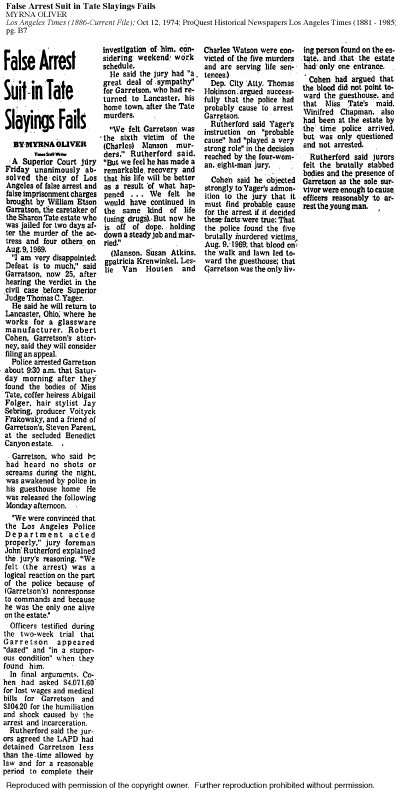 This is comedy gold- Garretson actually thought it was an outrage that the sole surviving person with FIVE dead bodies on an estate might be suspected. This AFTER laying to the police about what he heard and how he knew people like Parent.
The American pasttime of suing people- nice behavior.
I'm glad it got tossed.
Tuesday, July 04, 2006
BUGging Installment SEVEN
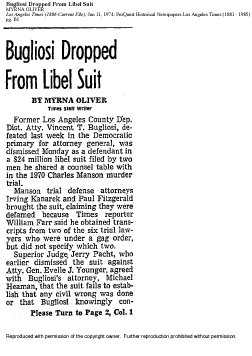
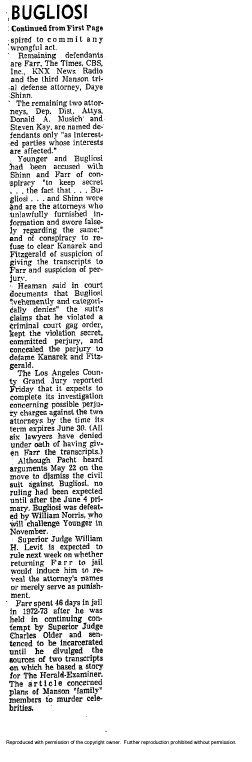 Here's more of the original lawsuit which apparently outed the BUG's perjury.
Kay basically confirms all we have learned.
Monday, July 03, 2006
Because You Requested It
Here is the opening of Bertice Berry. I do think I got the best part of the show the first time out. The only thing here of note is the vehemence of BUG as he calls Charlie a cold blooded killer, KNOWING that punkass Charlie never killed anyone. Otherwise, mostly just more Crazy Sandy.
Here is the opening of Bertice Berry. I do think I got the best part of the show the first time out. The only thing here of note is the vehemence of BUG as he calls Charlie a cold blooded killer, KNOWING that punkass Charlie never killed anyone. Otherwise, mostly just more Crazy Sandy.
Sunday, July 02, 2006
My Life With Charles Manson Chapter the Thirteenth

Chapter 13
Living in the midst of the
“Charlie’s right,” she told me. “
Life in the Yellow Submarine was intense. There always seemed such urgency in the air: we had to be ready when the shit came down. Instead of rejecting the real world, we were forced, at least temporarily, to become a part of it. Charlie began, gradually, to recruit a more macho element to assist us—mechanics, bikers, and ex-cons—who could score and repair dune buggies and Harleys, vehicles we needed for the desert. While he rarely allowed these guys into the inner circle of the Family, he kept them around, enticing them with girls and dope.
One of the new breed was Bill Vance (David Lee Hamic), an ex-con and friend of Charlie’s who had recently been released from prison. Through bill we got access to the
Karate Dave was another “heavy-duty” recruit who joined us during that period. He was twenty-six, a
Through Dave and bill, others were enlisted to help prepare for Helter-Skelter: guys to score motor parts, camping gear, tents, and building supplies; guys who could later work around the clock on various projects at Spahn’s and who knew nothing of the inner workings of the Family; men who were content to do what they were told to do in exchange for sexual gratification and good weed.
Not long after we met Dave, two new girls joined the Family, a petite, hippie brunette from
Charlie’s finesse in handling such diverse elements was extraordinary. While laying out his spiritual rap on the Family, creating a reverent, almost sacred feeling of brotherhood and intimacy, he was able to bullshit with the macho brigade in their own language, bringing them close to our scene but not close enough to really understand the subtleties of what was happening. While his female flower children made love to the rednecks and ex-cons, Charlie continued to woo the establishment of the music world—Dennis Wilson, Greg Jakobson, and Terry Melcher (Doris Day’s son), who he hoped would give us the break we needed. And all for a single purpose: Helter-Skelter. By the end of February 1969 we considered ourselves a band of tuned-in, spiritually hip revolutionaries—destined to make a mark on a decadent, disintegrated civilization.
By then my stint as a student at Birmingham High had come to an end. After two weeks of classes, I’d gotten bored, but not before luring several attractive girls to
“Motherfucker! Those little gals love your ass!”
Meanwhile, we practiced our music daily. Within a month of our arrival, we’d purchased all new sound equipment and tow new guitars. Through Dennis and Greg we lined up recording sessions at Brian Wilson’s studio. But none of them went well. Charlie liked to improvise, even during live recordings, and it just didn’t work. Invariably, our best sessions were outside the studio, in a relaxed atmosphere. Charlie wanted Terry Melcher, the owner of a record company, to come and hear us at
Charlie told us he thought it happened when Melcher promised to come to the house one evening and hear us. We cleaned the place thoroughly and set up the instruments and equipment in the living room. The girls prepared vegetables, lasagna, green salad, French bread, and freshly baked cookies. Then they rolled some good weed. We waited. All afternoon we waited. When Melcher didn’t show up (or call), Charlie was seething. “That motherfucker’s word isn’t worth a plugged nickel.”
Preparations for Helter-Skelter accelerated. By the middle of March we had purchased three dune buggies and three Harleys. We kept the dune buggies and three Harleys in the garage at
For hours we labored over the maps, pinpointing potential command posts and campsites along the way. By the end of the month we had the road pretty well laid out.
We began making sorties into Devil’s Canyon, scouting out the terrain in our dune buggies, plotting the road. It was a trip—racing over the sand dunes, looking out across the great expanse of the
At night, after the evening meal, Charlie rapped about our need to be unified: “Let go of the ego, let it die; just turn off your mind. Hey, things haven’t changed; it’s just that now we move with the time; now we got to make our scene of service. Yeah, there’s gonna be some shootin’ and dyin’, but that’s not new. There’s always been times in history when a lot of people die, and it don’t a thing to do with right or wrong or wing and wang…or diddly shit. It’s beyond all that, ‘cause the cosmic wind blows over the universe and man just reaps his karma whether he likes it or not.
“Hey, the Beatles have tuned into it. They’ve been tapping into the vibes for a long time. Look at their songs: songs sung all over the world by the young love; it ain’t nothin’ new. It’s all written down. It’s written in the good book, in Revelation, all about the four angels programming the holocaust…the four angels looking for the fifth angel to lead the people into the pit of fire…right out to Death Valley. Yeah, it’s alll been written down, so we might as well submit to it. It’s all in Revelation…Revelation is now! The Beatles are now! It’s all in black and white, in The White Album—white, so there ain’t mistakin’ the color---it’s all in the words and music. So listen and pay attention.”
Charlie spent hours quoting and interpreting Revelation to the Family, particularly verses from chapter 9:
And the four angels were loosed
Which were prepared for an hour
And a day, and a month, and a year,
For to slay the third part of men…
And the fifth angel sounded,
And I saw a star fall from heaven
Unto the earth: and to him was
Given the key to the bottomless pit.
The implications were clear: the four angels were the Beatles, whom Charlie considered prophets for what was coming down. The fifth angel was Charlie. “The third part of men,” he said was the white race, those who would die in Helter Skelter. The passage “And he opened the bottomless pit…And there came out of the smoke locusts upon the earth; and unto them was given as the scorpions of the earth have power” was not only a reference to the Beatles (locusts) but implied that the power of scorpion (Charlie was a Scorpio) would prevail. In describing the locusts (Beatles), Revelation said, “their faces were as the faces of men,” yet “they had the hair as the hair of women,” and “wore breastplates of fire,” which Charlie said were their electric guitars. Charlie read on: “And it was commanded them that they should not hurt the grass of the earth , neither any green thing, neither any tree.” Charlie maintained that cosmic wrath would only be leashed upon men and not on nature; that when the holocaust was over, the natural beauty would remain, and the world, at least in the desert, would be like
“When all the fightin’s over, the Muslims will come in and clean up the mess…’cause blackie has always cleaned up whitey’s mess. But blackie won’t be able to handle it and he’ll come over and say, “You know, I did my number, man…I killed them all and I’m tired of killing. The fightin’ is over.’ And that’s when we’ll scratch blackie’s fuzzy head and kick him in the butt and tell him to go pick the cotton.”
Charlie never hid his racial prejudices. And blacks weren’t the only ones he chided. He made jokes about Jews, particularly old Jewish men who lay around resort hotels with their comical penguin bodies, buying and selling humanity as though it were a commodity. He told
Later, people would ask me how a man like Charlie Manson could ever be considered Christlike. How could he ever get that close to people, so close to they spoke his rap and thought his thoughts. The answer is simple really: he listened to them, each of them. He concentrated on what they said. He sympathized with their problems, knew their idiosyncrasies. He allowed them to express all their fears, hope, aspirations. Seemingly, he did not judge, he merely listened and focused all his attention on them. He became friend, brother, lover, and father. He gave himself in a way that perhaps no one else ever had, particularly in the beginning. Ironically, few people ever really pay attention on that level. He taught the girls not only to love their minds but their bodies and to use them without inhibition. What he had started at Spahn’s, he continued at
At times he’d gather us together to preach about the psychology of women. Though he’d be addressing the girls, everyone was present.
“Dig it, this is the planet of women…the men are just guests here. I mean, everything is set up for women; they pretend it ain’t so, but it is. They’re the mothers, the ones who bear the life of new generations. It’s like they have the greatest creative energy going for them. But they need the seed of man, dig. It’s up to man to bring woman to life and to tap into her energy. Women need to be loved, and we should love them, not as little boys but as men. The trouble with society is that women have made little boys out of men. Mothers have cut the balls off their sons before they developed their sexuality…left them boys instead of men. That’s why women today are not satisfied…they want men but all they find are little boys.
“We have to treat our women like women but also like daughters. We gotta cultivate them like a garden of flowers so that they give us life, so that when we tap into them we will become energized. Women are like batteries that gotta be charged. We give to them and they give back to us. It’s like money in the bank. Women are cosmic creatures, beautiful and strong. But they also got a streak of the witch in them. All of them got it. They’re dangerous, dig; they can’t help but want to cut your balls off. That’s their game; sad but true. Hey, look at all the dudes running around without balls! Women got the motherfuckers. Still, we got to love them; they’re our daughters, our power. But we can’t be goin’ on their trip. If they do, why you just wind up singing those high notes yourself, dig; it’s a game; it’s always a game.”
It was clear that Charlie feared losing control over his women. As a child who had been beaten and deserted by his own mother, his fear and paranoia were to some extent understandable.
He spoke like a pimp. There was never any doubt that the girls belonged to him and that their favors were a gift, not from them, but from Charlie. “Your love is my love,” he would say. “It’s all one love; when you love someone, I am loving them; we are all loving them.”
Regardless of the mechanics (and theory), it worked; the girls in the Family adored Charlie; he knew each of them—their hang-ups, their likes, dislikes, phobias, their tastes in food, sex, music, their backgrounds—everything. Whenever someone appeared who might cause a problem to our scene—a narc, redneck, probation officer, anyone from the straight world—Charlie knew immediately which girl would be best suited to neutralize that person. He was masterful at this; to do it, he had to know his women well.
Standing beside Sadie in the kitchen one night at
Even when Charlie was gone, the intensity was almost the same: the only rap, Charlie’s rap. Sadie, Squeaky,
Sometime in March, Charlie began sending people out on creepy-crawly missions around
One night, shortly after Sadie and Ella had gotten home from dancing at a bar in the valley (it must have been around two a.m.), Charlie ordered them to go with
Around four p.m. the following day, Charlie asked me to take the jeep and drive Sadie to work at the club. Sadie had slept all morning; she was in good spirits as we pulled out of the driveway. “Hey, Paul, see that place?” She pointed to a white stucco house set off the road near the corner of Variel and Gresham. “That’s where we went last night, through that window…that one, see, next to the garage…walked right by this guy and his old lady, then right into the kitchen and had some orange juice and cookies. Then we split. They didn’t even twitch. We didn’t take anything—except for Bill; he grabbed a couple of credit cards for Charlie.”
Everything was for Charlie; every thought, action, gesture. It now seems hard to imagine that one person could hold such sway over so many. And it retrospect, it became clear that no one was more dominated by Charlie than Sadie. Had someone told me as we drove toward
When we got to the club, just off
“Nice ass,” one of them muttered.
“Yeah, and she can move it…I saw her dance in here last week.”
At that instant both men looked up and saw me as Sadie shouted, “See ya, Paul.”
“That your girlfriend?” one of them asked.
“Yeah.”
“Nice.”
“Yeah.”
Saturday, July 01, 2006
BUGging Installment SIX

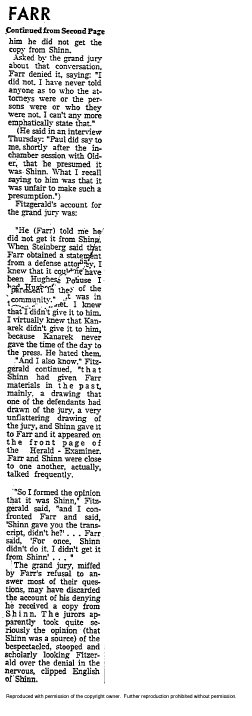
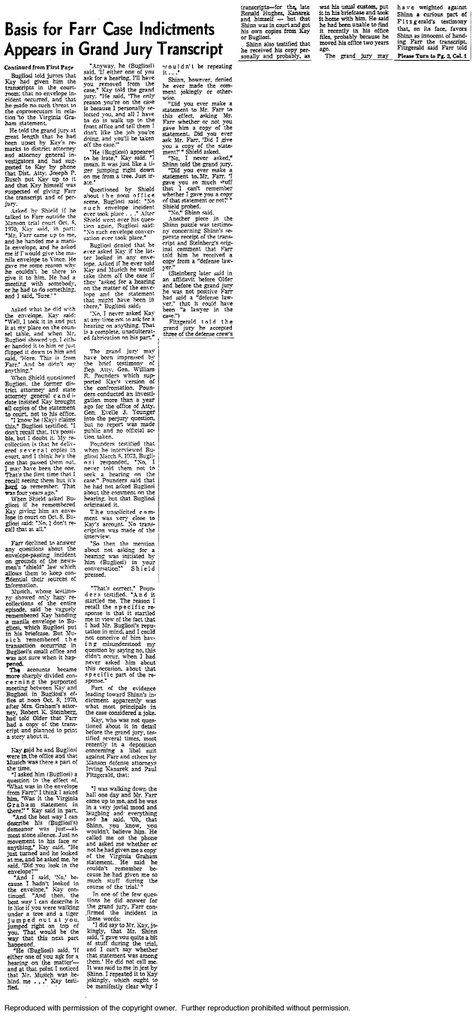
I think some of your still don't believe the Kay thing. Well here's more, where Kay actually states that BUG is full of merde. God I love this.
[To respond to Deb and Monk and Meat in the comments- Deb, the lawsuit was brought by Kanarek and Fitzgerald against Farr for libel. It was eventually tossed it looks like. Will try to find more. And while you can try to dismiss the BUG revelations as "dirty tricks" in a campaign, I have copies of the checks and settlement agreements in the Milkman case and the girlfriend case. I have a copy of the police report in the girlfriend beating which I will post this week. Maybe dirty tricks was the motive in revealing at that time but the illegal behavior of the BUG was done by BUG and BUG only. It happened, boys.
Also I should not have said that articles are proof- they aren't proof of anything except that THE COL IS NOT MAKING THIS INFORMATION UP.
And I do not have a stash of articles somewhere. I am paying to download them off the LA TIMES archives just like any of you could have done at any time if you had the right search criterion to punch in like I do thanks to YALKOWSKY.]
Subscribe to:
Posts (Atom)