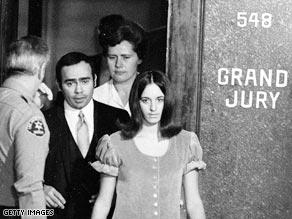
Tuesday, July 15, 2008

Denial not just in Egypt Anymore


Parole panel denies compassionate release for Manson follower Susan Atkins

She has served 37 years for killing actress Sharon Tate and others in 1969. Now doctors give her only months to live.
By Hector Becerra and Andrew Blankstein
Los Angeles Times Staff Writers

July 16, 2008

SACRAMENTO -- — A state parole panel today unanimously denied "compassionate release" for terminally-ill Manson follower Susan Atkins after hearing emotional testimony both for and against her release.

The 12-member State Board of Parole Hearing, as is customary, did not release any explanation for its decision.

Atkins, 60, played a central role in the 1969 slayings of pregnant actress Sharon Tate and others in a bloody two-night rampage in the Los Angeles area. She has served 37 years in prison, longer than any other female prisoner, officials said.

Now ill with brain cancer and with one leg amputated and the other paralyzed, Atkins has only months to live, doctors have said.

The petition for Atkins' release had ignited debate about when mercy is appropriate, particularly considering the grisly crimes for which she was convicted. With the rejection by the panel, the process is effectively over, making it highly likely that she will die in custody.

Those backing her release argued unsuccessfully that the cost of keeping Atkins in prison, which is estimated at $1.4 million for medical care and security just since March, should be a factor in favor of releasing her because it would save the state substantial amounts of money.

At the hearing today, Atkins supporters spoke first to the 12-member State Board of Parole Hearing.

"She has without a doubt, she has paid her debt to society," said her niece Sharisse Atkins, 17. "You see her as a part of the Manson family I see her as a part of our family. I hope you can find it in your heart to do the right thing."

Her supporters drew attention at the hearing to former Manson prosecutor Vincent Bugliosi's support for Atkins release. In an e-mail this week to Atkins' attorney, Bugliosi wrote that it was wrong to say "just because Susan Atkins showed no mercy to her victims, we therefore are duty-bound to follow her inhumanity and show no mercy to her."

Opponents of Atkins' release disagreed. They spoke today of their memories of learning of the murders and the effects of the killings on their families.

Tate, the wife of film director Roman Polanski, was 8 1/2 months pregnant when she and four others were killed at her hilltop home in Benedict Canyon. The actress, who was stabbed to death, had begged Atkins for her for her life.

"She asked me to let her baby live," Atkins told parole officials in 1993. "I told her I didn't have mercy for her."

At today's hearing, Pam Turner, Tate's cousin, sobbed, recalling being a child "so sick with grief that I wished I too could die."

Turner said she remembers the actress' mother "howling like a wounded animal" after hearing the news of the murders.

"My aunt's pain was palpable. She once put her hands on my pregnant belly and she cried," said Turner, alluding to the fact Tate had begged for the life of her unborn child. "She didn't say what she was crying about, but I knew."

Anthony DiMaria, whose uncle, Jay Sebring, was killed at the Tate's home, brought up news reports that Atkins' husband had called it "ridiculous" to spend so much money guarding his wife, who cannot even sit up in bed.

"To sum up these murders in terms of cost efficiency trivializes the victims' lives, and the lifelong impact on the victims' families," DiMaria said.

"There's discussion of dying with dignity.... the notion of dying with dignity is not determined by circumstance, but determined by choice," he told the panel. "Mrs. Atkins should die with dignity while serving out her sentence. My uncle died with dignity in the worst possible situation."

In addition to the testimony today, the board received about 100 letters, most opposing her release.

Los Angeles County Dist. Atty. Steve Cooley was among those opposing the release, saying Atkins' "horrific crimes alone warrant a denial of her request."

Suzan Hubbard, director of California's adult prisons, had previously expressed her opposition.

Orange County Dist. Atty. Tony Rackauckas also wrote the director of the Department of Corrections and Rehabilitation saying Atkins should remain behind bars and away from Orange County, where her husband lives.

The hearing today before the state Board of Parole Hearings is the third in a four-step process that allows inmates to seek compassionate release.

She cleared the initial steps when officials at her prison in Chino found that her case met the criteria for compassionate release review, a determination seconded by officials at corrections headquarters in Sacramento.

In addition to testimony, the board received information including Atkins' medical records, recommendations from state corrections officials and her criminal history as well as information related to her behavior while in prison and an assessment of whether her release would pose a risk to the public.

Even if the panel had decided to recommend compassionate release, Atkins would have awaited a final determination by a Los Angeles Superior Court judge.

Friday, July 11, 2008

The Manson Girls Continues


So the Col hears that the director and producer continue to try to make the Manson Girls movie. You know- the one we provided exclusive script excerpts from that made everyone laugh quite heartily. Lindsay Lohan walked away from this piece of shit, and these guys tried to spin it the other way. And I hear that they added another producer, one that was successfully sued a few years ago for $50 million plus dollars. It's sounds like the dream team- I mean after all, the director was removed from his last film- you don't get better talent than that, right?

Now we hear that rather than risk a lawsuit, the Dream Team has found Nancy Pitman and hired her as a consultant. I mean of all the immoral, evil fucking things I have ever heard. What will the credits say? Nancy Pitman, Convicted Murderess (accessory) (TWO DEATHS) and White Supremacist (Aryan Brotherhood member) who was dancing naked with Manson when the killers returned from slaughtering Sharon Tate - Special Advisor...

There is a good idea for an honest version of this story out there, but making it Nancy's POV is just wrong. Paying her is....sickening.

---------------
Excerpt from that Screenplay- did you know that Nancy had four kids to atone for all the killings?

EXT. NANCY/BRENDA’S HOUSE – DECK - DAY

FIFTY FIVE YEAR OLD, NANCY PITTMAN (BRENDA) sits at a table talking to her FOUR CHILDREN; aged from their teens to their 20’s, listening to her in silence.

NANCY (BRENDA)

I try not to dwell on these things I’ve done in my

life, because I know there’s nothing I can do to

change them… Tears are useless… I have to

look ahead...

(beat)

You’re my children… And you’re the means by

which I’ve tried to atone for the things I’ve done

and the choices I made back when I was a girl…

The kids look at one another in a state of total shock.

NANCY (BRENDA) cont.

And now you know who I am… I hope you won’t

judge me too harshly…

FADE TO:


EXT. SPAHN RANCH – NIGHT (FLASHBACK)

Brenda and Charlie dance in the moonlight.

Thursday, July 10, 2008

SORRY But NO


Let Me Die in Laguna Beach
Tony Rackauckas wades into the battle over Manson family killer Susan Atkins’ dying wish


It’s rare for Orange County District Attorney Tony Rackauckas to agree with the Los Angeles Times editorial board on anything. Credit Susan Atkins, the imprisoned former Charles Manson family member whose crimes shocked the nation in the summer of 1969, for allowing these ideological enemies to stumble onto common ground.

California’s Board of Parole will meet on July 15 to decide if Atkins, 60, qualifies for “compassionate release” from prison. The parole program is available to inmates who, like Atkins—an exemplary prisoner for nearly four decades—have six months or less to live or to those in a coma or vegetative state. In March, doctors were unsuccessful in attempts to remove Atkins’ brain tumor. They’ve also amputated one of her legs.

It’s anyone’s guess what the politically appointed board will do. It has rejected Atkins’ parole requests 11 times in 37 years. This time, however, she finally has won the support of famed Manson Family prosecutor Vincent Bugliosi, author of Helter Skelter, which chronicled the gang’s crime spree.

But Atkins gained an even bigger critic. After learning of the special parole request, the Times published a June editorial, “No Mercy.” It advised the parole board to keep her locked up, even while acknowledging she no longer poses a threat to society. “Atkins gravely wounded our collective peace, and society has a right, even the obligation, to exact vengeance,” the state’s largest daily newspaper opined. “For some criminals, including Atkins, the crime is so great that the price should be imprisonment until death.”

The vengeance line infuriated Eric P. Lampel, the veteran Irvine-based defense lawyer representing Atkins. He wrote to the Times, ridiculing the paper’s attitude and demanding corrections. The paper declined to cooperate. In a two-page letter to the paper, Lampel listed ways he claims the Times botched facts to reach its conclusion. They include:

.Atkins’ current sentence is seven years to life with the possibility of parole, not a life sentence.

.Atkins didn’t initiate the compassionate-release request; prison doctors did based on her rapidly declining condition.

.Although a co-conspirator, Atkins did not stab pregnant actress Sharon Tate to death; it was Charles “Tex” Watson, another Manson family member.

I’m not sure it is advisable for Atkins to minimize her role in the deaths now, but Lampel is determined to confront what he sees as a smear attack on his client in her final days.

“The Times terribly minimizes Susan’s efforts in her 37 years behind bars to apologize to the victims and their families, work toward helping herself and then others, paying restitution, and all the other honors and accomplishments she has received while incarcerated,” Lampel wrote in his letter titled, “No Mercy for Idiot Editors at the LA Times.” “You may not like [Atkins’] sentence and may disagree with it, but it is what it is, and she should have the right to be considered for parole—should have been out decades ago because she was the epitome of a model prisoner.”

Lampel also sent a June 16 letter to Arnold Schwarzenegger, asking him to have the courage to support the release and reminding the governor that he has met Atkins “several times” over the years at the women’s prison in Corona and “knows her as a person, not the media personification.”

“Susan is the longest-serving woman prisoner in the state of California, and her record is not merely immaculate, it is superhuman,” Lampel told the governor. “I beg you to show compassion for Susan’s family and allow them to care for her and to say goodbye to her in her final months.”

The governor’s office did not return my calls seeking comment.

In mid-June, I wrote a blog post that mentioned developments in the case and reminded readers what Atkins told me when I spoke to her six years ago (see “All In the Family,” April 26, 2002). If ever released from prison, she’d like to live in Laguna Beach. “It’s a beautiful place,” she said.

One of my readers was Rackauckas, who has often taken a no-mercy stance with convicted felons—especially killers. He sent a letter to the California Department of Corrections and Rehabilitation.

“I am adamantly opposed to the release of prisoner Susan Atkins,” Rackauckas wrote on June 25. He also summarized the brutal murder of Tate (who was eight months pregnant) and noted his view that Atkins had already been granted mercy in 1972 when the state supreme court overturned all death sentences, including hers.

But if parole-board members release Atkins, Rackauckas doesn’t want her living in Orange County. He says state law suggests that paroled inmates be returned to the county of their last legal residence, which—in Atkins’ case—may be somewhere in the California desert, where she lived with Manson in the 1960s.

“It would be a grave miscarriage of justice to burden the citizens of Orange County by paroling her [here], where she can enjoy the comforts of her husband, home and mercy she did not show Sharon Tate, her unborn baby and seven others,” wrote Rackauckas.

Lampel described the DA’s stance as “his typical uninformed blabbering.”

“Rackauckas makes it sound as if Susan is going to be shopping at South Coast Plaza, dining at the Ritz-Carlton and enjoying picturesque sunset walks on the beach,” he said. “Her left leg has been amputated. She has a brain tumor. She’s dying. She has a couple of months to live. If he’d bothered to check, he would know that even if she’s granted release, she’ll be stuck in a hospital bed.”

Husband James Whitehouse, an attorney who lives in San Juan Capistrano, also scoffs at what he sees as cheap political posturing that ignores another reality: two taxpayer-paid guards watch Atkins around the clock at an undisclosed hospital in the Inland Empire.

“[Her release will] benefit the state of California by eliminating the incredible costs of guarding and treating a person who can no longer even sit themselves up in bed, and for Susan’s family who will otherwise not get the chance to say goodbye to her,” he argues.

“Sorry, but no,” says Susan Kang Schroeder, public-affairs counsel for the DA’s office. “Certain crimes are so heinous you can’t put a cost on punishment. Sharon Tate and the rest of her victims didn’t get a chance to say goodbye to their loved ones.”

We Missed The LA Times Editorial on Sadie


No mercy for Tate murderer

Susan Atkins seeks release from prison because she is dying. But she deserves her sentence.
June 18, 2008

To allow Susan Atkins to die at home would be an act of mercy -- but not of justice. By the terms of justice, she forfeited her claim to freedom on an August night in 1969 when she murdered Sharon Tate. Tate begged for her life; Atkins slit her throat and then wrote "PIG" on the front door in the slain woman's blood. For her part in that and other ghoulish sprees as a member of the Manson family, Atkins was sentenced to die, only to be spared in 1972 when the state Supreme Court abolished the death penalty. Now, facing her own mortality, she seeks compassionate release. Her case thus frames two competing imperatives of the penal system -- the right of society to demand justice and the desire of humans to grant mercy.

As readers of this page know, we oppose the death penalty under all circumstances. Over the years, that conviction has led us to oppose the executions of many vile men and women, with one glaring exception -- that of Timothy McVeigh, whose punishment we welcomed in 1997. We now regret that editorial and have since returned to our steadfast opposition to state-sanctioned murder.

To oppose capital punishment, however, is not to oppose the notion that some people deserve to die in prison. Atkins has spent 37 years in custody, longer than any other woman in California's system. After so much time, the horror of her deeds as a young woman has given way to her own slow demise. She lost a leg and now suffers from terminal brain cancer. Given her fate, Atkins has attracted the sympathy of some who once actively condemned her crimes, notably Vincent Bugliosi, who prosecuted the Manson family. He and others argue that it is pointless -- a burden on taxpayers and an act without penal significance -- to allow Atkins to deteriorate and die behind bars.

Our system of justice attempts three noble aims: punishment, protection of society and deterrence (some would add rehabilitation). Atkins poses no physical threat to society. Her sentence and time in prison undoubtedly have sent a deterrent message to any would-be Mansonite still lurking out there. And she may well have been rehabilitated: While serving her sentence, Atkins has written a book, explored religions, taught classes. Has she been punished? Yes, of course; 37 years is not trivial. But Atkins gravely wounded our collective peace, and society has the right, even the obligation, to exact vengeance. For some criminals, including Atkins, the crime is so great that the price should be imprisonment until death.

Atkins rejected Tate's plea for mercy and now asks for ours. We do not support the government's right to kill her, but we would not grant her mercy either.

Tuesday, July 08, 2008

That's More of a Hearing Than Sharon Got


State Parole Board to hear Atkins' case for compassionate release


Download story podcast

10:00 PM PDT on Monday, July 7, 2008
By LAURIE LUCAS
The Press-Enterprise

The case for releasing Susan Atkins, the terminally ill follower of Charles Manson who killed actress Sharon Tate almost 40 years ago, will be heard by the state Parole Board in Sacramento on July 15.

The board will allow the public to address the board before the closed session begins.

No matter what the Parole Board of Hearings decides, the case will go to the original sentencing court in Los Angeles County, where a judge's decision would be final.

Officials at the California Institution for Women near Corona had recommended that Atkins, 60, an inmate, who is being treated at a hospital, be released because she meets the criteria of the state's compassionate release program. She has fewer than six months to live, no longer poses a threat and has a family to support her.

Atkins has brain cancer. Her attorney last month said doctors have given her two to three months to live.

The director of the state's adult prisons recommended that Atkins not be freed, but would not disclose her reasons because of confidentiality.

The Inland prison officials' bid to free Atkins has fueled a public outcry.

Tate, who was pregnant, and four others were murdered on Aug. 9, 1969, at the actress' home in the Benedict Canyon area of Los Angeles.

During a 1969 summer killing spree, the members of the Charles Manson family cult killed eight people. Atkins was convicted for her role and has been imprisoned for 37 years. She has been denied parole 12 times.


Friday, July 04, 2008

Happy Fourth Of July


--Monkeyboy Jim, having accomplished nothing with his blog is picking up the pieces of his sad life and moving on in three weeks. We hope he keeps the blog open as a monument to delusion and confusion. We'd like to point to it in the future as an example of mental illness.

-- Since Monkeyboy did NOT follow through on his promise to burn Sharon's photo or to piss on Leslie's photo, we have decided to kiss the photo of Sharon in a bikini. You can too.

-- 40 years ago today everything was cool on Spahn Ranch. Everybody was young and carefree with their lives ahead of them.

-- THIS blog will never close as long as BUG'S lie passes for the truth.

-- Vote NO on Helter Skelter!

Thursday, July 03, 2008

Go get a Coconut from Rio


So Sadie is dying and people are up in arms about releasing an unrepentant murderess from jail. Big surprise right? I mean I am glad she has found love and all but did she seriously expect to find forgiveness after her grand jury testimony? If anyone was watching the game she played they could see that she made every single move wrongly that she could. First boasting in prison. Then testifying while not in her right mind (look at the photos) . Then she HAD a deal with the DA. She wasn't going to walk but she WAS going to get out eventually. And she saw Charlie rubbing the sore ass she gave him and she flipped it away. So then she ends up indicted and in prison for life.

I have spent time in maximum security prisons, albeit male, albeit on the other side of the bars. There is NOTHING nice about them. Her life has been hard and fucked up. But then, thanks to her, over a half dozen lives are no more.

The point isn't about letting her out. Debra Tate is doing nothing to keep her there except gathering TV face time. She was NEVER getting out- none of them are.

The point is, if Susan gave a shit about what she has done- TELL SOMEONE THE TRUTH that you know about what happened- you have had almost four decades to reflect on this. Tell someone the truth. If it dies with you that is yet another sin against society.

Saturday, June 21, 2008

Koffee Klatch


----> I don't understand what the fuss is about. No one is going to release Susan Atkins from prison. It isn't going to happen. What she did was too heinous and too unforgivable for that to ever happen. Debra can gather more airtime for her ego. Idiots like Jim can argue "she only held Sharon down" as if that doesn't constitute murder. But in any case, she's not getting out. Like when I was right about Barker- I'm no genius, just let logic be your friend. DISCUSS.


----> I am a little confused by the reactions in some corners to the Steve Grogan news. It appears that Steve has lived a crime free life since being released from jail after a jury sentenced him to death. And that's great. But when MansonFamilyToday revealed the information there were actually people who protested about some imaginary right to be left the hell alone. Well Bret didn't advocate doing anything to the guy. He merely made a news story on his site that stated where Steve is now. Kind of a "whatever happened to" thing. Like after the movie HEAVENLY CREATURES when it came out that the Kate Winslet character/murderess was actually a bestselling mystery novelist. The age of the internet means that the truth will be available if someone cares enough. The silly tenets of Scientology are now known worldwide thanks to the net. The lame remarks of McCain are read the very next minute thanks to bloggers. Besides, Clem, I am told, did an extensive interview for the highly anticipated Tom O'Neill book on the case, his first interview in decades. The internet may be the way we finally get to the truth of the WHYS about TLB. DISCUSS.

----> I am confused by people both here and on other sites who pretend to be someone close to the case. Thelma and Louis is Wheat is Soybean is Dianne Young etc. who knows nothing and no one real. Think about it- if you were Cappy or Ouisch or Mary or even Clem you only do one of two things- you shut the fuck up and go on with your life OR you start a website that clearly establishes your bona fides and then you try to make some cash with it. You don't lurk and pretend on message boards. The only REAL person ever to show up on line was Steven Parent's friend who was a girl (not girlfriend) and no one really cared. Babs Hoyt shows up on news shows for money. Gypsy sells her friends down the river on news shows to promote a future book. There ain't nobody in the comments here or elsewhere who is an ex former one time wannabe FAMILY member. DISCUSS.

----> I got super pissed off last week when another fucking lie was disseminated by reporters that Susan Atkins had spent more time in jail that any woman in California. Because at the very least it's a tie with her and Katie. These "journalists" spewed the same bullshit over and over.
Then one of them did something about it!
DISCUSS.

---->Then it seems that somebody got snitty. What is the point to mention the length AT ALL? Why should the Prison note the length of somebody's stay except to say "poor prisoner has been here so long is that so wrong?" Personally I now love this Lindsay William-Ross person. They asked the hard question when not one other single reporter did. DISCUSS.


Sexy Sadie Asks For Mercy She Never Gave


Prison boss opposes release of ailing ex-Manson follower

LOS ANGELES, California (CNN) -- California's director of adult prisons is recommending against "compassionate release" for a terminally ill former Manson family member, a spokeswoman said.

Suzan Hubbard, director of the Division of Adult Institutions, decided that Susan Atkins' request should not be sent to the sentencing court for consideration, said Terry Thornton, spokeswoman for the California Department of Corrections and Rehabilitation.

Hubbard's recommendation is advisory and will not necessarily prevent Atkins' release.

The court -- not the department or the state Board of Parole Hearings -- has the final say on whether Atkins should be released, Thornton said. "They're the only ones legally who can recall the sentence," she added.

Atkins, 60, was convicted in the 1969 slayings of actress Sharon Tate and four others. She had been incarcerated at the California Institution for Women in Corona, California, but has been hospitalized since mid-March.

Her request is now before the Board of Parole Hearings, which is conducting an independent investigation and will hear the case during its monthly public meeting, Thornton said. The next meeting is scheduled July 15.

Atkins had been held for years at the Corona prison, which earlier determined that she met the criteria for compassionate release under the law, and sent her request to the corrections department.

The Board of Parole Hearings will receive public comment, discuss the request in closed session and then announce its recommendation. The board also can decide whether to refer the request to the sentencing court.

The court, based in Los Angeles, can either grant or deny Atkins' request. It also can recall her life sentence and resentence Atkins to a lesser term, allowing for her to be paroled.

In 2007, the department received 60 compassionate release requests, Thornton said. Ten were approved.

Citing privacy rules, prison officials would not disclose the nature of Atkins' illness. Her husband and attorney, James Whitehouse, has been quoted as saying she has terminal brain cancer, according to a blog called Manson Family Today. She also has had a leg amputated, the Los Angeles Times has reported.

Atkins, known within the Manson family as "Sadie Mae Glutz," has been in prison since 1971 and has been denied parole 11 times. She is California's longest-serving female inmate.

Tate and three houseguests were slain in August 1969 by killers who burst into her Benedict Canyon home. A teenager who was visiting the home's caretaker in his cottage on the property also was killed.

According to historical accounts of the murders, Atkins stabbed Tate, who was 8½ months pregnant, and wrote the word "pig" in blood on the door of the home the actress shared with her husband, director Roman Polanski.

The following night, Leno and Rosemary LaBianca were slain in their home in the Los Feliz neighborhood of Los Angeles. The two-day crime spree sent shock waves throughout Los Angeles.

All of the killers remain behind bars. Atkins also was convicted in the earlier murder of music teacher Gary Hinman.

Atkins, like family leader Charles Manson, received a death sentence. Her punishment was changed to life in prison when the California Supreme Court ruled the state's death penalty unconstitutional in 1972.

Atkins is a born-again Christian, according to a Web site maintained by her husband. During her incarceration, the site says, Atkins has worked to help at-risk youth, victims of violent crimes and homeless children.

Last month, authorities dug for buried bodies at the Inyo County, California, ranch where Manson and his followers once lived, after police became aware that testing had indicated humans might be buried there. Nothing was found, police said.

Monday, June 16, 2008

Pants on Fire

Bret points out that Debra is a big fat liar.

Give a hoot? Don't slash throats!

(anyone hear Jim from NY squawking in the background in his cave? Leslie! Leslie! Squawk!)

Thursday, June 12, 2008

Bug Says Yes But Debra Say NO


Sharon Tate's murderer could be released from prison soon


Download story podcast

10:00 PM PDT on Thursday, June 12, 2008
By PAIGE AUSTIN
The Press-Enterprise

The Manson family girl who helped stab Sharon Tate 16 times almost 40 years ago, refusing the pregnant actress' pleas for mercy, could soon be freed from prison.

Terminally ill Susan Atkins is being considered for "compassionate release," said state Department of Corrections spokeswoman Terry Thornton.

The Corrections Department is reviewing the request, and, ultimately, a state sentencing court would have the final say, Thornton said. It is a process that could take more than a month.

Atkins, 60, is being held at the California Institution for Women near Corona while being treated at a local hospital. State officials have declined to disclose the nature of her illness.

"I don't want to seem like a heartless creature, but in all my years, I never considered this could happen," said Debra Tate, the actress' sister and only surviving relative. "This is a serial killer and what kind of mercy did she show her victims? When you torture someone, you have no compassion. How do you ask others to give it to you? It is her duty, in order to pay for her crimes, to die in prison."

James W. Whitehouse, Atkins' husband and attorney, did not return calls for comment Thursday.

Compassionate releases are rare -- only 16 percent of requests in 2007 were granted.

Under state law, terminally ill inmates can be considered for early release so they can die with and at the expense of loved ones. Dying inmates must meet certain criteria, Thornton said. They must have six months or less to live and must not to be a threat to society, she said. They must also have committed family members willing and able to care for them.

In 2007, requests were submitted for 60 dying inmates, and prison officials recommended only 29 of those be freed, said Thornton. Of those 29, the state recommended 20 be released, she said. In the end, sentencing court judges approved the release of 10 terminally ill prisoners.

A diagnosis and evaluation of Atkins was conducted by prison officials, who concluded she met the requirements, Thornton said. If the Corrections Department recommends compassionate release, the Board of Parole would review the request and could recommend it to a sentencing court. The Board of Parole is next scheduled to meet July 15, the soonest the board could review the matter, said Thornton.

Once the request reaches the court, it would have 10 days to rule.

On Aug. 8, 1969, Atkins took part in the cult killings of five people at the Benedict Canyon home of Tate and her husband, director Roman Polanski.

Tate was 8 ½ months pregnant and begged for her child's life, Atkins confessed at a 1993 parole hearing.

"I told her I didn't have mercy for her," Atkins told the parole board. Atkins and another man stabbed Tate 16 times in the chest and back, and Atkins wrote on the wall in Tate's blood.

Atkins' 1971 conviction in connection with eight murders drew a death sentence, which later was commuted to a term of life in prison during a moratorium on the death penalty.

Atkins has been denied parole 12 times, said Thornton.

"She has been disciplinary free for most of her incarceration," Thornton said. Over 37 years in prison, she has worked as a laundress, teacher and clerk. She has taught pilates, written a book and been involved in religions of several faiths, said corrections officials.

"Of all the women currently incarcerated in California, she has been in prison the longest," Thornton said.

Haunted by the brutality of her sister's death, Tate said she struggled to find compassion for the convicted killer.

"She showed no compassion. She told my sister as she slit her throat that she didn't (care) for her or her unborn baby," Tate said.

"If I could, I would say to her that I would pray for forgiveness on her soul at her moment of death when she has paid her debt to society. At that point, I'll show compassion and pray for her soul."

She has no Mercy for Sharon


Prison officials may free Manson family's Susan Atkins due to illness

Woman convicted in the 1969 murder of actress Sharon Tate reportedly has less than six months to live. Sources say she has brain cancer and one of her legs has been amputated.
By Andrew Blankstein and Hector Becerra
Los Angeles Times Staff Writers

June 13, 2008

State corrections officials are considering a request by former Charles Manson follower and convicted murderer Susan Atkins to be released from prison because of an undisclosed terminal illness.

Atkins' initial request for "compassionate release" consideration was made last month after a doctor determined that she had less than six months to live, said Terry Thornton, spokeswoman for the state Department of Corrections and Rehabilitation. It is unclear if Atkins, 59, made the request or if it was made on her behalf by a doctor or family member.

Citing medical confidentiality laws, Thornton said she could not disclose the nature of the illness. But sources close to the case said that Atkins had suffered from brain cancer and had undergone amputation of one of her legs.

Atkins has been in state prison 37 years, longer than any other female inmate in California, Thornton said. She is serving a life sentence with the possibility of parole, making her eligible for release.

Atkins and other members of Manson's cult were convicted of killing actress Sharon Tate and six other people during a bloody rampage in the Los Angeles area over two nights in 1969. Tate, the wife of director Roman Polanski, was 8 1/2 months pregnant when she was killed at her hilltop home in Benedict Canyon.

Atkins was also convicted of the earlier killing of music teacher Gary Hinman.

Her request for release has already been approved by the California Institution for Women in Corona, where she was housed from April 1971 until March, when she was transferred to a local hospital for treatment.

Officials at the Corona facility concluded that Atkins should be considered for release because of her failing health and because she no longer posed a risk to others.

Several obstacles remain, however. Her bid for release must still be approved by officials at the state Department of Corrections and Rehabilitation, Thornton said. A positive recommendation would send her case to the state Board of Parole, which would conduct an investigation and issue its own findings, she said. That hearing could include public comment.

Vincent Bugliosi, who prosecuted Atkins, said she deserved the death penalty in 1971. But the former prosecutor said he believed now that Atkins has sincerely renounced Manson and that her 37 years in prison, along with her illness, changed things.

"She has paid substantially, though not completely, for her horrendous crimes. Paying completely would mean imposing the death penalty," Bugliosi said. "But given that she has six months to live, and the loss of her leg, I don't have an objection to her being released."

Last month, sheriff's deputies and forensic experts began searching for buried human remains at a sun-scorched ranch in Inyo County once used as a hangout by the Manson family. For decades, rumors have persisted that graves existed at the ranch.

Investigators used ground-penetrating radar, magnetometers and shovels at the Barker Ranch but did not find any human remains. They did find a .38-caliber bullet casing, but it was unclear whether it was related to Manson.

Wednesday, June 11, 2008

Let Polanski Go!


Polanski victim wants case closed but no prison

By Michelle Nichols
Reuters
Wednesday, June 4, 2008; 9:16 AM

NEW YORK (Reuters) - Oscar-winning movie director Roman Polanski should not have to serve time in prison for unlawfully having sex with a 13-year-old girl 30 years ago, the victim now says.

The French-Polish filmmaker fled the United States to France in 1978 before he was sentenced and Samantha Geimer, now 45 years old with three sons, said in an interview she wants the case resolved.

"I don't think he's a danger to society," said Geimer, who settled a confidential civil suit with Polanski more than 10 years ago. "I don't think he needs to be locked up forever and no one has ever come out ever besides me and accused him of anything."

A documentary, "Roman Polanski: Wanted and Desired," which debuted at the Sundance Film Festival and will air on U.S. cable channel HBO on Monday, throws the spotlight on the case.

"It was all so overwhelming," said Geimer, who lives in Hawaii and works as a personal assistant and bookkeeper. "I think we just wanted it to be over and sending him to jail was not going to help it be over.

"What happened that night, it's hard to believe, but it paled in comparison to what happened to me in the next year of my life," she said of the media frenzy surrounding the trial, adding that she was relieved when Polanski fled because the media attention died down.

The filmmaker, now 74, was charged with several counts, including rape by use of drugs, but in a deal pleaded guilty to unlawful sex with a minor, a crime committed during a photo session with Geimer. He bolted to France, where he is a citizen and cannot be extradited by the United States, before he was sentenced.

'HE'S SORRY'

Polanski, who directed "Rosemary's Baby" and "Chinatown," already had spent 42 days in a prison for a psychiatric evaluation before his sentencing.

"I think he's sorry, I think he knows it was wrong," Geimer said. "He should have been given time served ... he needs to make a deal to be treated fairly when he gets back here and with his celebrity I think that's going to be hard."

At the time of the court case, psychiatric experts did not consider Polanski a sexual predator and both the defense and prosecution believed probation would be sufficient punishment.

Documentary director Marina Zenovich tracked down Polanski's lawyer, Geimer, her attorney, law enforcement officials, film industry colleagues and reporters who covered the case, among others to dig deeper into the case.

They all revealed troubling behavior by the judge, now deceased, who was so driven by media coverage that he kept a scrapbook of clippings. The film implied that Polanski fled because he feared unfair treatment amid the media frenzy.

Polanski, whose pregnant wife, actress Sharon Tate, was murdered by followers of Charles Manson in 1969, rebuilt his life and career in France and in 2003 won a best director Oscar for "The Pianist."

He declined to be interviewed by Zenovich for the documentary, which used archival interview footage.

"It was 30 years ago now," said Geimer, adding that she had spoken about it so often she was emotionally detached. "It's an unpleasant memory ... (but) I can live with it."

(Editing by Mark Egan and Bill Trott)

Friday, June 06, 2008

The World Stops on Its Axis


I got an email from a former reader....

ColScott,

Just a short comment! After being called such colorful names ("uneducated Red State freak," "sow,"bitch," "welfare/food stamp receipient") back on 7/19/05 for stating that I thought Debra Tate's motives were less than honorable (and not so much about her sister Sharon's memory), I find it rich that now I suddenly take a look at your blog (at the urging of a California friend) and you've suddenly jumped off the "Debra bandwagon." What happened to "her sister was slain in one of the most awful ways I can think of and you say 'but' ??? And what about "we here at the only OFFICIAL Tate-LaBianca site wish Debra.......nothing but the best in their battle for truth." Sounds like you guys are wishing her LESS THAN THE BEST these days (which is fine and dandy by me).
Why the sudden turn, ColScott? Could it be that I was right all along? I don't expect that you would ever say "You know, Caryn, you were right and I was wrong and I certainly owe you an apology." That's something you would never do, but I really don't need it anyway.
Now, here's the part where you copy and paste this email into your blog and start with a whole new round of insults. Just for the record, though, you'll need to come up with something besides "Red State freak" (if you consider South Carolina a "red state") because I know reside in sunny West Palm Beach, Florida. I wouldn't want you to be called "misinformed."

"Granny" Caryn

You know Caryn, you WERE right and I WAS wrong and I certainly owe you an apology.

Thursday, June 05, 2008

TIN HOUSE Part 2


This confuses me because they act like JUANITA is a made up name. But if you read Paul Watkins' book (check out July 2006 on this site) it seems to be her real name. Juanita Wildebush. And Bob the guy she married having the last name Berry. Not sure what the big deal is. But the interview is intriguing because, well, she points out the truth- big CM wasn't all that bad.

"Juanita" (not her actual name) was on a road trip from San Jose, California, to Mexico via Phoenix, Arizona. In Mexico she was going to try to reunite with her fiancé, from whom she was estranged. By her account, she had had a "harrowing afternoon" the day before, because her van had been broken into and her very expensive stereo system, which she had felt the immediate need to replace before the long trip ahead, stolen. Because of that and because of the state of her romantic relationship, she was, as are most people at the point they are inducted into cult organizations, in an emotionally fragile and vulnerable state. South of San Jose, she stopped to pick up a pregnant-looking hitchhiker who turned out to be accompanied by two men. All three were from the Manson Family. The woman was Susan Atkins, later one of the Tate-LaBianca killers. The essence of Juanita's story is this: she got into the Manson cult by accident, and she got out, nine months later, not long before the murders, by another stroke of fate, in that case probably a stroke of great luck as well. The interview was conducted circa 1984-85. At that time, Juanita was happily married and a successfully practicing professional.

WIN McCORMACK: So, Susan Atkins was the first Manson Family member you met, when you picked her and two male companions up hitchhiking in Northern California. What was she like?

JUANITA: I knew her as Sadie Marie Glutz. Sadie was a kid, a twenty-something-year-old kid. I have lots of really fond memories of her. It destroys me when I think about what happened to her, because she tried real hard to do the right thing. Sort of screwed up all along the line in her choices. Sadie was in the passenger's seat, and the guys were in the back. I remember her talking about their musical group. That was their story. They were all members of a band, and their band's name was the Family Jams. I remember TJ [Thomas Walleman, or "TJ the Terrible"] saying, "Oh yes, we record with Dennis Wilson and the Beach Boys and we use their studios." Dennis Wilson was very much a part of the "peripheral family." I remember Sadie telling me very intently what a wonderful group it was and how neat, how much it meant to her, and how it really worked as her family. I talked to her about Mexico and how I was engaged to a guy living there. This was the end of September 1968. I was going to be twenty-four next month. She talked to me about how wonderful this place was where they lived near Los Angeles. She talked with the fervor of somebody who'd been converted. [EDITOR"S NOTE: Susan Atkins was involved in the Tate murders and the prior murder of Gary Hinman, a graduate student who dealt drugs to the Family. As recounted in Vincent Bugliosi's book Helter Skelter and in The Family by Ed Sanders, during the Hinman killing, after Manson follower Bobby Beausoleil stabbed Hinman twice in the chest and he lay bleeding to death, Atkins put a pillow over his head to suffocate him. Regarding the killing of Sharon Tate through multiple stab wounds from several different knives, which Atkins participated in, Atkins once recounted to a cell mate how pregnant Sharon Tate had begged for her life and the life of her baby, and how she had responded: "Look, bitch, I don't care about you. I don't care if you're going to have a baby. You'd better be ready. You're going to die." She went on to say that the first time she stabbed Tate, "It felt so good."]

WM: Tell me about your first encounter with Charles Manson.

J: My intention had been to drop the three of them off and to drive on to Phoenix on the way to Mexico to hook up with my fiancé. I totally misjudged how long it would take to drive the length of California, so by the time we drove into Spahn's Movie Ranch near Los Angeles, I was exhausted. They said, "Why don't you stay here?" There was a whole sort of façade of Western town buildings and then off to the right was a trailer with its lights on. Everybody said, "Let's go get Charlie," and everyone went running in. Charlie came out naked. He had been making love to a woman named Gypsy, and she also came out naked. Nobody reacted to that. Nobody thought anything of this. It seemed like the most noticeable thing to me. Everyone was hugging each other, everybody was so happy to see everybody else. They said, "Oh, look what we found, look who we found," and introduced me to Charlie. And he came over and put his arms around me and said how glad he was. Of course, this was the '60s, when everybody was hugging, but there really was a lot of love around that trailer. There was real bonding. It's the same kind of stuff, that same kind of open and unthinking love that you see in the face of a Moonie. Charlie got a guitar out and everybody started singing. It was just wonderful fun, but it was very clear that nobody had any talent. I felt perfectly comfortable with them. That night, Charlie asked if he could spend the night with me in the camper and I told him no. He let me know that I was being selfish and self-centered and that there was a deficit in my character.

WM: You decided to stick around there rather than driving on to Phoenix and then Mexico to meet up with your fiancé as you had planned. Why?

J: The wooing began almost immediately. Somebody came along and brought me breakfast, then Charlie came along and brought me coffee. From dawn on I had somebody around to tell me how wonderful it was there and I don't think I ever spent another five minutes alone until several weeks later. At the time, this was a group of people who lived my philosophy - make love, not war - all of those things. At least, to all appearances, that's what they did! Life on the ranch then was just one great big make-believe time. There was a real spring back in the woods. You'd take a shower under a waterfall. You could run through the woods naked. There were horses to ride. It was a magical kind of place.

WM: You became one of Charlie's lovers very quickly, I believe. How did that happen?

J: I didn't know then how to say no to anybody. And then I was real nerdy too. And here were all these girls, women, falling all over him. And it was my door he was knocking on.

We went off to Malibu in my camper just a few days after I had gotten there. A man called Chuck, and Sadie and Charlie and I. My camper was one of those pop-up ones with a bunk at the top and a bunk at the bottom. And we had gone over there and dropped some acid. We spent the night there and on the beach, and in the morning, when dawn was breaking as it were, Charlie and I started making love, and Charlie told Chuck and Sadie to come down into the same bunk we were in. And I tolerated that, although we did not have group sex. I tolerated that, and that seemed to be significant to Charlie. And I remember after that Chuck and I went for a walk on the beach, and I said, "What's this guy all about?" And Chuck said he was this really powerful, wonderful person.

He was a good lover. Probably the most phenomenal lover I've ever had. But once I was hooked, he didn't have much to do with me.

WM: What made Charlie such a good lover?

J: What makes anyone a good lover? He was very tender.

WM: Charles Manson was tender?

J: Very. I never saw that man do anything that was hurtful. I really didn't. There is a very incongruous aspect to all of this for me.

WM: Tell me more about Charlie.

J: He was not particularly big - probably five-two. Really wiry, real agile. Almost leprechaunish in some ways, with a quick wit. There was a real playful quality about him, an endearing quality about him. He could be very much the little boy, and he showed a vulnerable side that really got you engaged in taking care of him.

WM: How did he show his vulnerable side?

J: I remember one time - this was at Spahn's, and it was even very possibly that same night I gave him all my money. There were kittens all over the place. The mother cat had stopped cleaning up after them. They had messed in the kitchen. And Charlie got down on his hands and knees and cleaned the kitchen floor. He cleaned up after the kittens. He picked them up and put them inside his shirt and went and sat by the fire and warmed the kittens and played mother cat. I remember him looking up and saying, "I now understand the pain of too much tenderness, because it hurts not to hug them. But if I were to hug them I would hurt them." It was those kinds of things. He showed himself or acted like a very, very gentle man that would never hurt anything.

WM: Would he cry?

J: I did see him cry one time. There was one night, again at Spahn's, where everybody took megadoses of acid and probably some mescaline or something else mixed in with it. Things got really out of hand. I mean really royally. The hallucination that I had that night was one of being in a tent in Arabia where horses were jumping through the tents and all this wild pandemonium was going on. People were hitting each other. The place was literally destroyed. I remember Little Paul Watkins hit me that night. There was pandemonium. Everybody was on their own trip. And Charlie came in to get a pair of shoes and he said to me , "I can't stay here, because there's no love here anymore."

He said, "Tomorrow you have to tell them that they drove me away." And the tears were just flowing down on his face. I asked him to stay, and he said no, he couldn't stay. He said that the animal had come out in them and that love had fled.

WM: You say you have him all your money?

J: It was amazing how quickly Charlie read me. He seemed to know all the right button to push. Within a month I'd signed over my camper and something like a sixteen-thousand-dollar trust fund, which in 1968 wasn't small potatoes.

WM: How did he get you to do that?

J: That's a question I've asked myself many times. Some of it was drug-included. I'm sure. I can remember the night that I told him he could have the money. That day, we started early dropping acid and doing all those kinds of wonderful things. He had been telling me that the thing stood me and the total peace of mind and heart was Daddy's money- I was not going to be free of Daddy until I got free of Daddy's money. Charlie started [saying] that I was my father's ego. And I remember thinking, That doesn't make any sense to me. Then later I convinced myself that it probably was [right], because Charlie was always right. Charlie never openly said that he was the reincarnation of Jesus Christ, but if he didn’t say it, he sure to hell implied it. He would day things about having flashbacks about having the nails driven in through his wrists. He said, "The nails weren't put in my palms, but they were put into my wrists." And, "They always lie to us. Everything's 180 degrees from the way they told me it was. And there is no difference between Jesus and the devil. So your daddy would say I'm devil, but of course I am, because if they told you that good was right, then obviously evil is right. So then I must be the devil, because I'm right."

One of the things we did with my money, which I still feel real good about, was [take care of] the sweet old man who owned the ranch, George Spahn. All of us lived there for free and ran the place for him, because George was blind and eighty-six years old. We cooked for him, and we washed his clothes, and we gave him back rubs and we told him how wonderful he was. George was in danger losing his ranch to back taxes. He hadn't paid taxes and it was coming down to the wire- pay up or lose it. I signed over the money to Charlie and we paid six years' worth of taxes on it. [EDITOR'S NOTE: Bugliosi says in Helter Skelter that one of the ways the Family kept Spahn happy was by having Squeaky Fromme- the family member who subsequently tried to assassinate President Ford- and other Manson girls minister to him sexually "night after night." ]

WM: Did you get to know Leslie Van Houten?

J: Leslie was just a really sweet, personable girl. She had short dark hair and this bubbly way about her. Her father had been or still was a big muckety-muck architect or something in Los Angeles. And my parents were very conservative and very pro-establishment, so she and I used to talk about how no matter what we did, we couldn't be good enough to please these outrageous parents of ours. I remember the last time I saw her we were all out in the desert and we were sitting around the kitchen in the ranch, and Leslie was talking about how we really were her family now, and how she had never felt so close to any of her blood relatives. I just remember how close to her I felt. I really liked her. I think a lot of us always were in awe of each other. [EDITOR'S NOTE: Leslie Van Houten participated in the killing of Rosemary LaBianca - albeit apparently somewhat reluctantly at first. As described in The Family: "Leslie was not participating. Tex [Watson] wanted Leslie to stab. So did Katie [Patricia Krenwinkel]. Leslie was very hesitant about but they kept suggesting it. She made a stab to the buttocks. Then she kept stabbing, sixteen times. Later, the nineteen-year-old girl from Cedar Falls, Iowa, would write poems about it."]

WM: Did you know Tex Watson well?

J: Tex was the mildest-mannered, most polite human being you've ever seen. He was one of those people that called you "ma'am" all the time, called everybody ma'am. He was from Texas. Real handsome but sort of baby-faced handsome. He wanted to go back to school or do something, and Charlie kept telling him not to bother, that it was a waste of time. I remember talking about him wanting to go back to school. I remember, when I heard that he was involved in the murders, being very surprised because he was just this really sweet guy. [EDITOR'S NOTE: By the accounts of Sanders and Bugliosi, Tex Watson was not only the leader but also the most savage and bloodthirsty member of the Tate and LaBianca death squads. At the Polanski/Tate property he shot Steven Parent four times in the head; shot Jay Sebring in the armpit and then drop-kicked him in the nose before stabbing him four times; sliced Abigail Folger's neck, smashed her head with the butt of his pistol, and stabbed her in various parts of her chest and abdomen.; shot Wojciech Frykowski below the left axilla and then finished him off by stabbing him in the left side of his body; and was one of those involved in stabbing Sharon Tate sixteen times. He personally killed Leno LaBianca by slashing him four times in the throat. When he had first come upon Frykowski and Frykowski asked him who he was, he replied, "I am the devil and I am here to do the devil's work."

WM: Getting back to Charlie, in addition to his expressing kinship or identification with the devil, did he ever talk about Hitler? A number of leaders of destructive cults over the years have expressed admiration for Hitler, and particularly of his treatment of Jews.

J: I remember Charlie talk[ing] about Hitler having been right - that the world needed a big purging every once in a while. And I remember saying to Charlie, "If Hitler were here now I'd be dead." And he laughed and said, "No, you missed the point. It's got nothing to do with whether or not you've got Jewish blood. It has to do with purging the world, and having only people who can survive - the only thing that was wrong with those people is that they weren't smart enough to figure out how to escape it."

WM: Manson also talked a lot about race wars, didn't he? Wasn't that the foundation of his "Helter Skelter" ideology and ultimately what led the Family to murder?

J: What was going to happen in this backward world to make it right was that the black man, who had been oppressed for years, was going to become the superior race, and the blacks would rule the world. "Helter Skelter" was Charlie's plan for and name for their uprising and also, it turned out, apparently, for the murders which he hoped would provoke that. [EDITOR'S NOTE: Manson hoped that the murders would be thought to have been committed by blacks, bringing even further oppression down on them, in turn provoking them to rise up.] The reason we had to find a place in the desert was we had to have a place to run and hide, because as whites we were going to be killed or enslaved unless we were smart enough to find a place to live until - until it all balanced out. Eventually, the black man would ask Charlie and the Family to take over, because he wouldn't be able to rule on his own.

We didn't call it "Helter Skelter" until the Beatles record came down, and then it was, "Aha, look at that - our prophets." It's only in the last two years that I've even been able to tolerate listening to The White Album.

WM: Was that really going on, what Helter Skelter describes as the mental preparation and buildup for the murders - playing the songs "Helter Skelter," "Piggies," "Revolution 9," and "Blackbird" from the album over and over? The line in "Blackbird" that goes, "All your life, you have only waited for this moment to arise," which supposedly referred to the rising up of the blacks?

J: All of that was going on.

WM: When did you first go to the desert, or, more specifically, to the Barker Ranch in Death Valley?

J: Sometime in October. Halloween weekend of 1968, I think, was when we first went to the desert. Then, in February of '69, everyone went back to the Spahn Ranch except for me and Brooks Poston, who had been one of the stable-hands at Spahn's, who always wanted to join the Family, but Charlie had never truly accepted him.

So Brooks and I stayed at Barker. They were supposed to get us in ten days, but nobody had ever come back from Spahn's. We were there alone when Paul Crockett and [his partner] showed up. They came on March 10 or 11. They had pulled up to the farmhouse and it was difficult for us to either invite them in or send them away. We couldn't do either. And Paul said that was his first clue [that we were under the influence of mind control]. We didn't know how to speak for ourselves at all. We came out and told them that the place was taken. But Paul just said, Well, it's night, code of the desert, and all that sort of stuff. He and [his partner] had food, and we had very little. [EDITOR'S NOTE: Juanita later married Paul Crockett's partner, whose name is being withheld here for purposes of anonymity.]

WM: What were they doing up in the desert?

J: Prospecting for gold. Paul Crockett had studied with one of the early, early people who were of Ron Hubbard's ilk - one of the first five people that L. Ron Hubbard, later the founder of Scientology, had studied with himself. This man had known Ron Hubbard when he used to say things like, "Well, you know how to really make it in this world is to start your own religion. Nobody can touch you, and you can really do it. Maybe I ought to take this stuff and can it." And that man had told Paul the reason he wasn't a Scientologist was that he didn't like the amount of control that was happening in that organization.

WM: In other words, Paul Crockett knew a thing or two about cults and brainwashing. And also deprogramming?

J: Paul essentially deprogrammed Brooks and me, and later Paul Watkins, Charlie's sometime right-hand man. One of the things that he talked about was the way Charlie got control over everybody by getting people to agree that he was something spectacular, and agree to his other self-serving ideas. He said the agreements are much more powerful than people realize they are, and that implied agreements are more powerful than overt agreements. It was those implied agreements that were making it very difficult for us to break away from him. Paul and Brooks and I used to stay up until one, two, three o'clock in the morning just talking. Doing what were early Scientology experiments. I don't know whether they're still done. I don't know anything about Scientology now at all, other than the fact that Paul has warned me not to get involved with them, because they are as hard to get away from as Charlie was. [EDITOR'S NOTE: According to Bugliosi, Manson went through Scientology training while in prison in the late '50s and early '60s, and claimed to have achieved Scientology's highest level, "Theta Clear." Bugliosi also claims that Manson often used the phrase "cease to exist," a Scientology exhortation.]

WM: So how did you finally extricate yourself from the Family?

J: Well, one day, Paul Watkins showed up from Spahn with a woman named Barbara. They were very interested in Brooks and me and what happened to us, because it was very clear to them that we were alive again. It was also very clear to us that they weren't alive. Barbara - Bo - was somebody that always fought Charlie. She just wouldn't give up, she just wouldn't give in. And he worked on her and worked on her and worked on her. One time she was stoned and we were all sitting with the fire going and sort of chanting and I remember her really freaking out and saying, "You're all evil, this is hell," and Charlie saying, "Well, of course it's hell. Remember everything that Mommy ever taught you is wrong. Where you want to be is hell. And we're all devils." I remember Barbara standing there and screaming at him, "I'm not going to do it. I'm not going to give myself away to you." Yet she stayed.

The word was that they had been sent up to get us and to bring us home, to bring us back down. And we told them we weren't going. And they stayed for several days, ostensibly to talk us into going. But it was very, very clear that they really wanted to find out what had happened. And Bo in particular jus kept saying, "You're really staying here, and you're happy?" And I kept saying, "Yeah, I am." Paul Crocket gave them just enough to make them interested in breaking away and getting some sense of individuality again. But Paul Watkins said, "No, I've got to go back and see Charlie. We're not looking forward to telling him that Brooks and Juanita aren't coming back."

WM: How did you leave it with Charlie?

J: Brooks and I asked Paul [Watkins] to do something very specific. We asked him to wait until the whole Family was together at night, when everybody was there, and to say that we wanted Charlie to release us from any agreements he had made with us. We asked him to do it in front of everybody because Charlie couldn't turn down requests in front of everybody, because he was the servant and not the leader, according to his teaching. He said, "Of course. They're released. Nobody has any agreements to us, to me." He said, "I don't have any holds on anybody." And so Watkins said, "Well, then, do you release me from any agreements with you?" And Charlie said, "Of course." And Barbara said, "And me?" And Charlie said, "Yeah." And Paul looked around the room at the rest of the Family members - this is the way he told the story - and said, "And what about them?" And Charlie said, "Enough of this shit about agreements," and wouldn't release anybody else.

Paul came back up in June, escaped, and never went back to Manson. I never saw or heard of Bo again. It was at Barker Ranch, by the way, that Charlie was arrested.

WM: You and your future husband left Barker Ranch in June of 1969 and the sensational murders took place in August. When did you hear about them and what was your reaction?

J: My future husband and I went off to some place out near Baker, California, to look for turquoise, and then to Kingman, Arizona, where his brother lived, to stay for a while and work. And that's where we were the August weekend that the murders happened. I'm watching the TV and the news broadcaster is saying how bizarre the murders were, and that there was a place on this door where the word pig had been written. And I looked at that and said, "It doesn't say 'pig,' it says 'die.'" [EDITOR'S NOTE: It did in fact say "pig." The word was written in Sharon Tate's blood.] I just somehow knew it was them. It had been at least since February since I had seen any of them, other than Paul and Barbara or had any contact with any of them, except for one phone call. It was intuitive, because id didn't make any sense. It was totally incongruous to what they said and how they lived when was there. But at the same time, I looked at that. I was sure it didn't say "pig," that it said "die." And that was a big part of it - there was this whole thing of you had to die and be reborn. Until you could let your old ego die and be reborn, you couldn't be free. There was this whole thing of dropping acid and experiencing death. And I remember these people writhing on the floor, and Charlie saying, "Die, let yourself go. Die." Standing there and looking at them: "Die, die."

I remember that experience. I'm a very quick study. That's how he got my money so fast. But I remember being back at Spahn's Ranch, way back, the first couple of weeks I was there - when Charlie was telling me to die. And he said, "All you have to do is just go with me and I'll take you, because I've already died. I'm not afraid." He just stared at me. And I just stared at him. The intensity of that man's eyes. I had literally given myself away to him by then.

WM: You never saw a sadistic or brutal or psychopathic side to Manson?

J: No. It's one of the things that's scariest of all. The person that I saw I was, for all outward appearances, everything he said he was. He'd give you the shirt off his back, literally. He got down on his hands and knees and cleaned up cat shit. I never saw this other side of him.

WM: The whole thing must be haunting for you.

J: Have you ever read anything about the Vietnam vet survivor-guilt business? I have survivor guilt. Real survivor guilt. Leslie and Sadie are in prison and I'm living a relatively nice lifestyle. I mean, why me? How did I get out? Why did I get out? Why did they get caught? I don't know that either.

WM: Did you ever see Charlie again, on television?

J: I saw him during the trial, on television. And it was real scary for me. He was angry and intense. Very different than I had seen him. If anybody had said to me in July of that year that these murders would happen, I would have told them that they were full of it. I would have told them that it was impossible.

WM: What if you'd been there? What if you hadn't been deprogrammed? Do you think that you would have been involved in the murders?

J: My fear is that if I were there I'd be in jail now too. Because I pretty well did whatever he told me to do. I mean, for me to walk forty miles, as I did one time - I had blisters on the soles of my feet that were two and a half inches in diameter… because Charlie wanted me to go somewhere and I didn't have a car, so I walked. The basic programming was that you had to die to be freed anyway, so death was not something to be afraid of. That we were all members of one greater consciousness. But the other thing was that if Charlie said, "Jump," my only question would be, "How high?"

Wednesday, June 04, 2008

TIN HOUSE Part 1


Sometimes you never know where an article is going to appear. This appeared two years ago in TIN HOUSE. This will be a two part post. The interview is part two. Not much to say about part one. Lots of Babbling. The photo is a sunset on Mars. Cause it is purty.


THE DICHOTOMY OF EVIL

The Manson Girl Who Got Away

Win McCormack

A house on Romero Canyon Road, in the Montecito section of Santa Barbara, California, the evening of Saturday, August 9, 1969. There were five of us present: four of us - myself, Richard, Jan, and Ruth (my girlfriend that summer) - were Junior Fellows at the Center for the Study of Democratic Institutions in Santa Barbara, and there was Jan's wife, Barbara. We were all in our early to mid-twenties. As dusk fell over the eucalyptus and lemon trees surrounding the house, we dropped acid. As it turned out, this was not the right night for this group of people to do that.

All afternoon the news had been filled with reports of a grisly and bizarre quintuple murder that had take place after midnight in a mansion at 10050 Cielo Drive off Benedict Canyon in Bel-Air, an exclusive residential area of Los Angeles about eighty-five miles southeast of Santa Barbara. The mansion was the residence at that time of director Roman Polanski and his wife, actress Sharon Tate. When the police arrived that morning they found, in the living room of the mansion, the bodies of Sharon Tate and Jay Sebring, an internationally known hair designer who was Tate's former lover and now friend to her and Polanski, and on the front lawn the bodies of Abigail Folger, a Folger-coffee heiress, and her lover, Wojciech Frykowski, a playboy and friend of Polanski from his filmmaking days in Poland. Two of these victims - Sebring and Frykowski - had been shot. All four of them had been stabbed multiple times. Frykowski had also been struck on the head with a blunt instrument. The police found another victim as well, a young man named Steve parent, who had been visiting the grounds caretaker in his nearby cottage, slumped over the wheel of a car near the gate to the property. He had been shot four times. Someone had climbed the telephone pole, with a pair of wire clippers, and cut all four telephone wires to the house. On the front door the word PIG was written in blood that, after analysis, proved to be Sharon Tate's. Blood was everywhere - throughout the house, on the front porch, on the lawn. Witnesses described the sanguinary scene as a "battlefield" and a "human slaughterhouse."

Since it was the midst of summer, it did not get dark until fairly late that night on August 9. By the time darkness had consumed the house on Romero Canyon Road, Richard, Jan, Barbara, Ruth, and I were fairly well stoned. Suddenly Jan, a philosophy graduate of Reed College with a strong penchant for getting caught up in twisted and protracted flights of fancy, started talking about the murders in Bel-Air. He alluded to some of the details of the murder scene and to the names of some of the victims. Then he said that even as we sat there, the murderers could be in our vicinity; in fact, they could be right outside the house at that very moment. He emphasized the fact that the murders the night before had taken place in a canyon, and we were in a canyon, and the two canyons were not that far from each other; we could easily be reached by car, just as the victims the night before must have been. He also pointed out that the number of people in our house, five, was the exact number as had been murdered at the Polanski residence. He went on about all this at some length, until we finally told him to shut up.

Even had we not been stoned on LSD, this kind of talk, under the psychological conditions prevailing in Southern California that night, would have induced paranoia in the rest of us. We stood up and went to the windows and looked out. Of course, if you look out the window of a brightly lit house into the darkness, you don't see much of anything. Romero Canyon was an extremely quiet area, but there are always noises and, in the night, they tend to be mysterious ones. We drew all the curtains on three sides of the living room and in the dining room. We locked the doors. Then we went around the house and made sure all the windows were closed, and pulled down all the window shades. We turned out as many lights as we could and still find our way around the house, and then huddled around the dining room table for a feeling of solidarity. Every once in a while one of us got up and pulled aside a curtain a fraction and peered out to check on things. I don't think any of us got any sleep that night.

But besides the definite feeling of menace, there was a feeling of being menaced specifically by evil, an almost palpable evil. Of course, we were not the only ones in a state of fear in Southern California that night. And as it happened, that fear was justified. Just after midnight, Rosemary and Leno LaBianca were brutally slaughtered in their home at 3301 Waverly Drive in the Los Feliz area of Los Angeles, near Griffith Park. They too were killed with multiple knife wounds. The police found a fork protruding from Leno's stomach and a knife still piercing his throat. On a wall of the LaBianca's house was written in their blood DEATH TO PIGS and RISE and HEALTER SKELTER (so misspelled). This was the news that Ruth and I woke up to on Monday, after our LSD trip had wound down and we caught up on our sleep.

Years later, in the '80s, when I was studying and writing about the Indian guru Bhagwan Shree Rajneesh and his aggressive cult in Central Oregon for Oregon Magazine, I had another, more direct encounter with the existence and palpability of real evil. At his ashram in India, before he came to Oregon, Rajneesh had involved his followers in prostitution throughout Asia, international drug smuggling, and violent-encounter groups in which occurred numerous rapes (in the name of sexual liberation) as well as physical abuse resulting in at least one death. Rajneesh forced his women followers into abortions and sterilizations (he didn't countenance childbearing). In Oregon, Rajneesh followers were eventually implicated in the poisoning of restaurant patrons in The Dalles, the seat of Wasco County, with salmonella, and the attempted poisonings of two Wasco County commissioners, in a plot to gain control of the Wasco County Commission so that the incorporation of the city Rajneeshpuram, which Rajneesh megalomaniacally aspired to build, would be approved. Examining the history and behavior of Rajneesh honed my sense that evil and an evil path in life are, at least in key cases, deliberately and consciously chosen.

Rajneesh mesmerized his followers with a stupefying amalgam of Eastern mystical mumbo jumbo (Rajneesh, like Charles Manson, talked frequently about the need to "lose" or "give up" the ego) and the language and techniques of the then-prevalent humanistic psychologist of the era, after reading some of Rajneesh's literature in 1978, noted that Rajneesh "explains and justifies the slaughter of Jews throughout history," and wrote that "almost from the beginning I have had the feeling that this is a man who is deeply, deeply evil - evil on a scale almost outside the limits of the human imagination." Rajneesh adherent Shannon Jo Ryan, whose father, Congressman Leo Ryan, was gunned down at Jonestown, once stated: "I've heard other people say that if [Rajneesh] asked them to kill themselves, they would do it. If [Rajneesh] asked them to kill someone else, they would do it… I don't know if my trust in him is that total. I would like it to be." Rajneesh himself said the following: "When you surrender, you have surrendered all possibility of saying no. Whatsoever the situation, you will not say no."

My sense of evil as a consciously chosen path had originated, however, in my familiarity with the Center for Feeling Therapy, a purported "therapeutic community" that flourished in Los Angeles in the '70s. Center "therapists," led by head "therapist" and leader Richard "Riggs" Corriere (who did not countenance childbearing among his followers either), employed a combination of abreactive/regressive psychological techniques, which they had learned from Primal Therapy guru Arthur Janov, and coercive social techniques of group therapy to gain control of their patients psyches and lives. (Some three hundred "patients" lived together near the therapists' "compound" in the area of West Hollywood.) The Center for Feeling Therapy broke up in two days in late 1980 amid revelations about what had been going on behind the scenes there, including sexual and financial exploitation of patients. Afterward, while researching transcripts at the Esalen Institute in Big Sur, California. I discovered that three Center therapists, in 1972, not long after the Center's founding, had held something called the "Esalen Seminar on Feeling Therapy." During this "seminar" one of the therapists, describing the abreactive techniques they used to regress patients back to the helplessness of childhood, said that these techniques "were so powerful" that they could use them to manipulate and control their patients, "if we wanted to." This therapist added: "Hitler did that, you know."

One of the revelations during the Center's breakup was that Richard Corriere had been lecturing his therapy group on the virtues of Adolph Hitler. Among other statements Corriere had made was this: "If Hitler had won World War II, he would have eventually done good for the world, because all human beings, deep down, want to do good." Rajneesh had also alluded to Hitler (in the book The Mustard Seed, which Brandon referenced), claiming, "Jews are always in search of their Adolph Hitlers, someone who can kill them - then they feel at ease." And Charles Manson, the evil mind behind what came to be called the "Tate-LaBianca killings," according to his prosecutor, Vincent Bugliosi, told his followers that "Hitler had the best answer to everything" and that he was "a tuned-in guy who leveled the karma of the Jews." The reason for such cult leaders' fascination with Hitler seems clear enough. In his turn, Charles Manson himself has become something of a symbol and magnet for those drawn to the phenomenological power of evil. He still receives a volume of mail from admirers. One neo-Nazi wrote Manson that his discovery of Manson "could only be compared" to his earlier discovery of Adolph Hitler and the National Socialist Party.

When I was a senior in high school, my history teacher assigned us to watch a series of films about Hitler's Nuremburg rallies. Sitting there in a small darkened room with a few other students, watching images of Hitler flicker on the small screen, not being present in that immense stadium with thousands of chanting people, listening to the magnetic timbre of Hitler's voice without understanding a word of the language other than Die Juden and Judenfrei, I still found Hitler a preternaturally compelling figure, even at that distance in time. It was spooky, and not a little scary. What if you had actually been there? What if you had actually been German, and understood what he was saying? What if you felt resentment at the treatment of Germany by the Allies after World War I? What if you didn't know any Jews personally and were suspicious of them? In any case, it might have been hard in the context of those rallies to emotionally resist Hitler's hysterical entreaties and propaganda, especially juxtaposed with the hysterically passionate responses of the crowds. And that, I think, is what our history teacher sent us to learn about and contemplate. Which brings me to my next, and final, topic.

I choose to call it "The Dichotomy of Evil" (as opposed to "The Banality of Evil"). On the one side of my dichotomy are those, like the subject of the interview below, who manifestly did not ever consciously set out to follow the path of evil, but who were skillfully guided and manipulated in that direction by those on the other side of the dichotomy, those who combine intense charisma with a keen sense of how to find and gain control of followers, with diabolical purpose and intent. Adolph Hitler, Jim Jones, Rajneesh, Riggs Corriere, David Koresh, Charles Manson. What is the responsibility of the people on the first side of the dichotomy for the actions they have been manipulated and duped into? What is the responsibility of the German people as a whole for what happened in Germany in the '30s and during World War II, a question that has been probed and debated endlessly? At the Esalen Institute, I once observed a Gestalt therapy session in which a grown woman was, through a painstaking - and painful - therapeutic process, reduced to a quivering, lost, lonely, sobbing child. The therapist, if he had "wanted to," if he had possessed malign intent, could probably have taken this woman over completely at that moment and made her agree to almost anything he desired